
Mauritius and the Mascarene ArchipelagoGeographic and Volcanic OriginsMauritius is part of the Mascarene Archipelago, which also includes Reunion Island, and Rodrigues. Situated near the Réunion hotspot, Mauritius is an island of volcanic origin that formed through successive volcanic activity. This activity can be categorized into three main phases, each characterized by distinct lava flows: the Older, Intermediate, and Younger Series. These eruptions primarily involved basaltic lavas, contributing to the island's formation through the accumulation of shield volcano deposits rather than collapsed calderas. These lava flows have been isotopically dated using K-Ar dating methods, ranging from (as per McDougall & Chamalaun, 1969):
Coastal Formation and Marine DepthThe island's coastline thus owes its formation to the seaward flow of lava, which has, over time, been subject to the vagaries of nature. There is no continental shelf proper, as the waters swiftly descend to depths of 3,000 meters within a mere 20 kilometers from the coastline in the east, west, and south. In the north, there is shallower prolongation which includes Flat Island, Round Island and Serpent Island (with depths < 100 m); the prolongations extending way north up to Seychelles region. Historical Sea Level VariationsSea levels in the Mascarenes region have undergone geological changes over a significant time scale. Approximately 20,000 years ago, during the last ice age, sea levels were around 120 meters below their current levels. Following the retreat of glaciers and the release of substantial water into the ocean, sea levels experienced a rapid rise until about 6,000 years ago, when the rate of increase significantly slowed (Dean and Dalrymple, 2002). In addition to global sea level changes, localized variations occur due to factors such as land movement and the warming of seawater, leading to its expansion. Coastal Diversity and Habitat FeaturesThere is quite a diversity in the features of the coast from east to west and from the north to south. For instance, on parts of the south coast being subjected directly to wave action, the coastline is generally smooth, and the substrata are exposed as basaltic cliffs, revealing basalt boulders. Otherwise, the coastline provides numerous sandy beaches and some important bays; other indentations are at the entrance of river mouths. The coastal habitats comprise of exposed cliffs, beaches, dunes, saltwater wetlands, mangroves, estuaries, lagoons, sheltered bays, and coral reefs. Coral Reefs and Beach DynamicsThe shallow continental shelf's presence has fostered the development of an impressively intricate coral reef system. Over time, coral reef degradation and sea shell abrasion contributed to the creation of white sandy beaches encircling the island. Additionally, in the North West, at the mouth of Grand Riviere North West, black sandy beaches of terrestrial origin formed through the weathering of basalt rocks. The coastline of Mauritius has undergone shaping by winds, waves, and cyclones (McIntire and Walker, 1964). The prevalent beach types in Mauritius are sandy beaches composed of carbonate sediments derived from coral reefs and shells, deposited along the low-lying coastlines of the recent series lavas. Lagoon CharacteristicsThe island is encircled by a lagoon, except in regions where coral reefs are not present. The lagoon's width varies across different locations, typically ranging from a few tens of meters to several hundred meters along the west, north, and south, with minimal or no lagoon in areas lacking coral reefs. On the east side, the lagoon stretches over 2 km. At low spring tides, its depth is generally less than 1 m, while in areas with channels within the fringing and barrier reefs, it may exceed 20 m. The lagoon is predominantly filled with sand and, in certain areas, broken corals. | 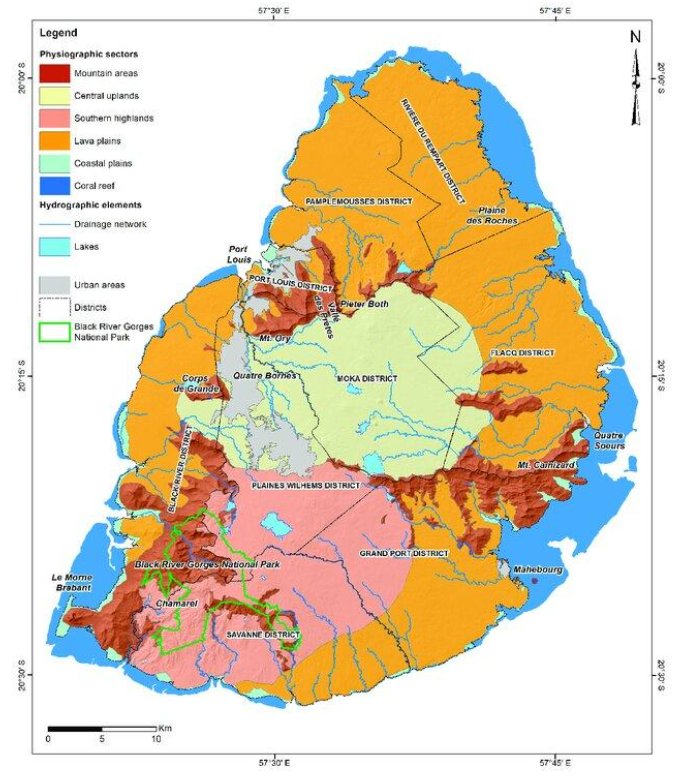 Sensitivity Index and Percentage Shore Length of Different Shore Types of Mauritius Coastline
(Source: Runghen et al, 2009) |
Shoreline Changes
The shoreline geomorphology in Mauritius is undergoing changes due to both natural forces and human interventions, a trend that will persist with the projected accelerated sea level rise (IPCC 2023).
Coastal Erosion and Sea Level Rise
The issue of coastal erosion is exacerbated by predicted sea level rise, with a potential loss of an average of 59m of beach according to the Bruun rule for a 59 cm rise (Dean and Dalrymple, 2002). Recent years have witnessed accelerated sea level rise.
Challenges in Coastal Management
Immediate concerns involve inadequate coastal development planning, coastal erosion due to human activities, and ineffective enforcement of legislation regarding construction proximity to the high water mark. Whilst the Government had initiated coastal erosion monitoring two decades ago, it is only recently that studies for increased setback lines have been initiated with a vision to integrating climate change and sea level rise considerations into coastal development plans, and stricter enforcement of coastal regulations.
Storm Surges and Cyclonic Impact
Significant storm surges, arising from long swells generated far to the south of Mauritius, have become an annual occurrence. Extreme storm surges occurred in May 1976 and on 31 May and 01 June 1987 where swells of around 3 to 4 m caused damage along the coast. Cyclones cause immense flooding and damage and loss of valuable infrastructure in many low lying areas along the coast.
Broader Environmental Concerns
Accelerated sea level rise, coupled with storm surges, is posing serious concerns for flooding in low-lying areas and exacerbating coastal erosion rates in all Indian Ocean islands. Pollution in the lagoons is a growing concern in Mauritius, primarily stemming from land-based sources, including domestic, industrial, and agricultural pollution.
Ocean Acidification
The increased atmospheric emission of carbon dioxide is anticipated to lower the pH value of seawater (ocean acidification). A decrease in pH from 8.1 in the 1990s to 7.9 by 2050 is expected, posing a threat to coral reef growth, including the supply of sand to lagoons and beaches.