

Greenhouse gases occur naturally and are essential for sustaining life on Earth by warming the air near the surface. However, human activities are now increasing the concentration of these gases in the atmosphere, leading to changes in the climate. These climate changes are already impacting various aspects of human life, including agriculture.
What are GHG Emissions?Greenhouse gases are chemical compounds in the atmosphere that play a crucial role in regulating Earth's temperature. These gases allow sunlight (shortwave radiation) to pass through the atmosphere, warming the land and oceans. As the Earth absorbs this heat, it releases it as infrared light (longwave radiation), which is invisible to the human eye. While some of this infrared light escapes back into space, greenhouse gases absorb a portion of it and radiate the heat back towards the Earth's surface. This process, known as the greenhouse effect, is a natural phenomenon that keeps our planet warm enough to support life. Without the greenhouse effect, Earth's average surface temperature would be about 33°C colder, making our current way of life impossible. Certain gases in the atmosphere have the ability to absorb heat. These greenhouse gases are generated through both natural processes and human activities. The main ones include:
| ||
Why Do Greenhouse Gas Levels Matter?The levels of greenhouse gases in the atmosphere have become a significant concern, particularly because their concentrations have increased dramatically over the past 200 years, coinciding with large-scale industrialization. The combustion of fossil fuels releases carbon stored deep within the Earth into the atmosphere as carbon dioxide. Similarly, when land is cleared for agriculture, the carbon stored in soils and plants is released as carbon dioxide. While greenhouse gases like carbon dioxide, methane, and nitrous oxide occur naturally and are essential for sustaining life on Earth, human activities have led to a substantial rise in their atmospheric concentrations. This is crucial because there is a strong scientific consensus among climatologists, atmospheric chemists, and other experts that the increasing levels of greenhouse gases are causing a rise in the Earth’s average global temperature. The Intergovernmental Panel on Climate Change (IPCC) has reported that the Earth’s average global surface temperature has increased by approximately 0.6° to 0.9° C over the past century, and this rise is very likely driven by human activities. Even though this temperature increase might seem small, it can lead to significant changes at the local level. For instance, some regions, such as the Arctic, are experiencing much more substantial warming than others. These temperature shifts are altering patterns of rainfall, snowfall, droughts, cloudiness, humidity, and the length of growing seasons, all of which can have profound impacts on agriculture and other aspects of human life. | ||
Do All Greenhouse Gases Have the Same Effect?Not all greenhouse gases have the same impact on global warming; they differ in their ability to absorb heat and remain in the atmosphere. Scientists use two key terms to differentiate the effects of various greenhouse gases: Global Warming Potential (GWP): Carbon Dioxide Equivalents (CO2-eq): Even as the global climate continues to change, there are effective strategies to mitigate climate change by both reducing greenhouse gas emissions and removing carbon dioxide from the atmosphere. Reducing our dependence on fossil fuels, investing in alternative energy sources, and adopting more efficient technologies can significantly decrease greenhouse gas emissions. Additionally, carbon sequestration—removing carbon dioxide from the atmosphere and storing it permanently—offers another important mitigation strategy. This can be achieved through practices such as planting trees or crops that absorb carbon dioxide via photosynthesis and store it in their roots, wood, or soil organic matter. |
| |
Note: As seen from table, the GWP of CH4 witnessed a 33.3% increase in AR5 as compared to AR2, whereas GWP of N2O witnessed a 14.5% reduction. These changes in GWP have resulted in variation in the projected BAU emissions especially for IPPU, Waste and AFOLU sectors where HFCs, CH4 and N2O are the major gages emitted. For BTR (2024), as such a time series correction of the GHG inventory from 2000 to 2016 was carried out using AR5 GWP values. The recalculated emission figures were also used to project the BAU scenario emissions till 2030 using the same Exponential Smoothing technique and maintaining same seasonality values. | 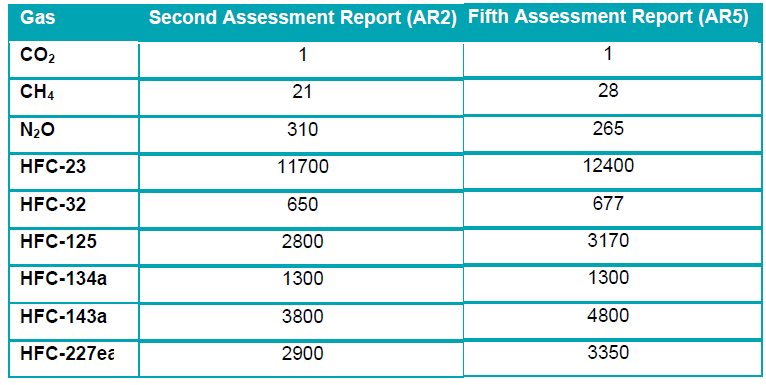 |