
Monitoring and controlling air pollutants is crucial to safeguarding air quality and protecting human health and the environment. The specific pollutants of concern can vary depending on the region, industrial activities, and local sources of emissions. Air pollution is monitored through air quality systems that include an Air Quality Index (AQI).
Air Quality Indexing (AQI) System for Mauritius | ||
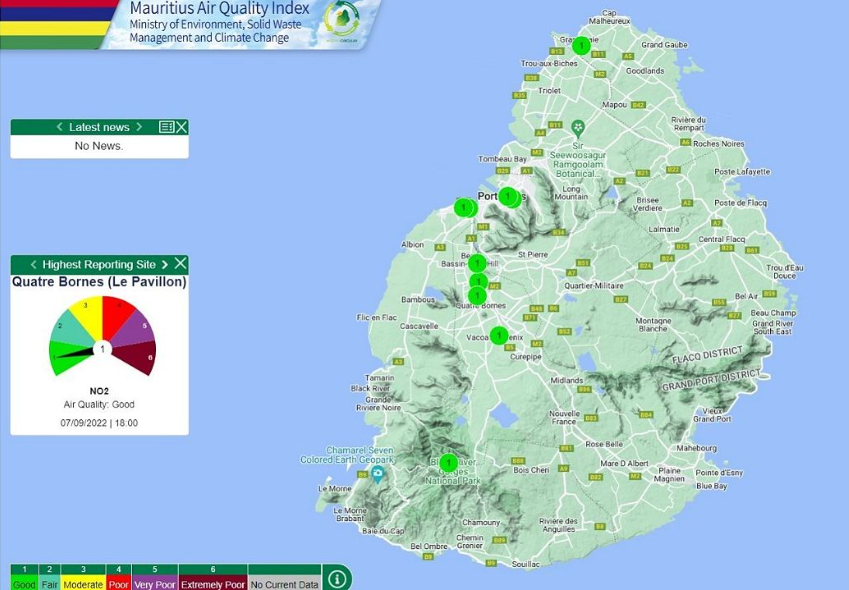
The AQI System for Mauritius was launched on 07 September 2022 at the National Environmental Laboratory in Réduit, at the initiative of Ministry of Environment, Solid Waste Management and Climate Change on the occasion of the International Day of Clean Air for blue skies. The aim of the AQI is to collect and analyse data in view to reduce levels of key air pollutants and improve the quality of air, in line with World Health Organization (WHO) Guidelines. Air Quality is monitored at various strategic locations in Mauritius. The AQI system comprises six fixed stations and four Internet of Things (IoT) sensors deployed around the island linked through a central network system which disseminates hourly and daily indices. The main objectives of the system are to:
| see also WHO Air Pollution (Overview, Impacts and More) see also WHO Database (Mauritius)
| |
How is the Air Quality Index (AQI) Computed? | ||
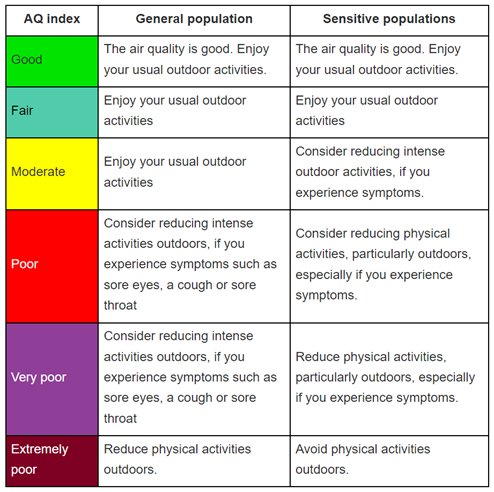
The AQI system is a tool used by government agencies worldwide to communicate to the public in a simplified manner (using colour code) the prevailing air quality in a given region by knowing how clean or polluted our air is, and what associated health effects might be of concern to them. The AQI is computed based on the concentration of key air pollutants being monitored, and then color-coded to indicate the level of health concern for the general public. The AQI calculated for each region is displayed on a web portal and is accessible on https://airquality.govmu.org or via Quick Links on the Ministry’s official website. |
| |
 Information collected by the system can easily be accessed by the public and tourists through dedicated web portal, mobile applications and dedicated electronic billboards display.