

Click HERE1, HERE2 to access solid waste management infographics and indicators
Some Definitions
Domestic Extraction (DE) per capita: The amount of raw materials (biomass, fossil fuels, metals, and minerals) extracted from the domestic territory for use in the economy, divided by the population. It reflects local resource pressure.
Domestic Material Consumption (DMC) per capita: The total quantity of materials directly used by an economy (domestic extraction + imports - exports), divided by the population. It indicates the overall material footprint within a country.
Domestic Material Input (DMI) per capita: The sum of all materials entering the economy (domestic extraction + imports), divided by the population. Unlike DMC, it does not deduct exports and therefore reflects the total input available.
Exports per capita: The amount of raw materials and products (in physical tonnes) sent out of the domestic economy to other countries, divided by the population. It shows the intensity of material outflows per person.
Imports per capita: The amount of raw materials and products (in physical tonnes) brought into the economy from abroad, divided by the population. It reflects the reliance on external material resources per person.
Physical Trade Balance (PTB) per capita: The difference between imports and exports of materials, divided by the population. A positive PTB indicates net material imports, while a negative PTB indicates net exports.
Material Intensity: The amount of material used per unit of economic output, often expressed as Domestic Material Consumption (DMC) relative to Gross Domestic Product (GDP). A high material intensity means the economy requires more resources to produce a unit of value. It is an indicator of the resource dependence of an economy.
Material Productivity: The economic value generated per unit of material consumed, expressed as GDP relative to DMC.
While the trend for Imports has been increasing that, for exports, has been relatively constant. The overall consumption levels have been steadily growing in Mauritius over the last three decades. In 2022, 2201 products were exported and 3854 products were imported (source: wits, world bank)
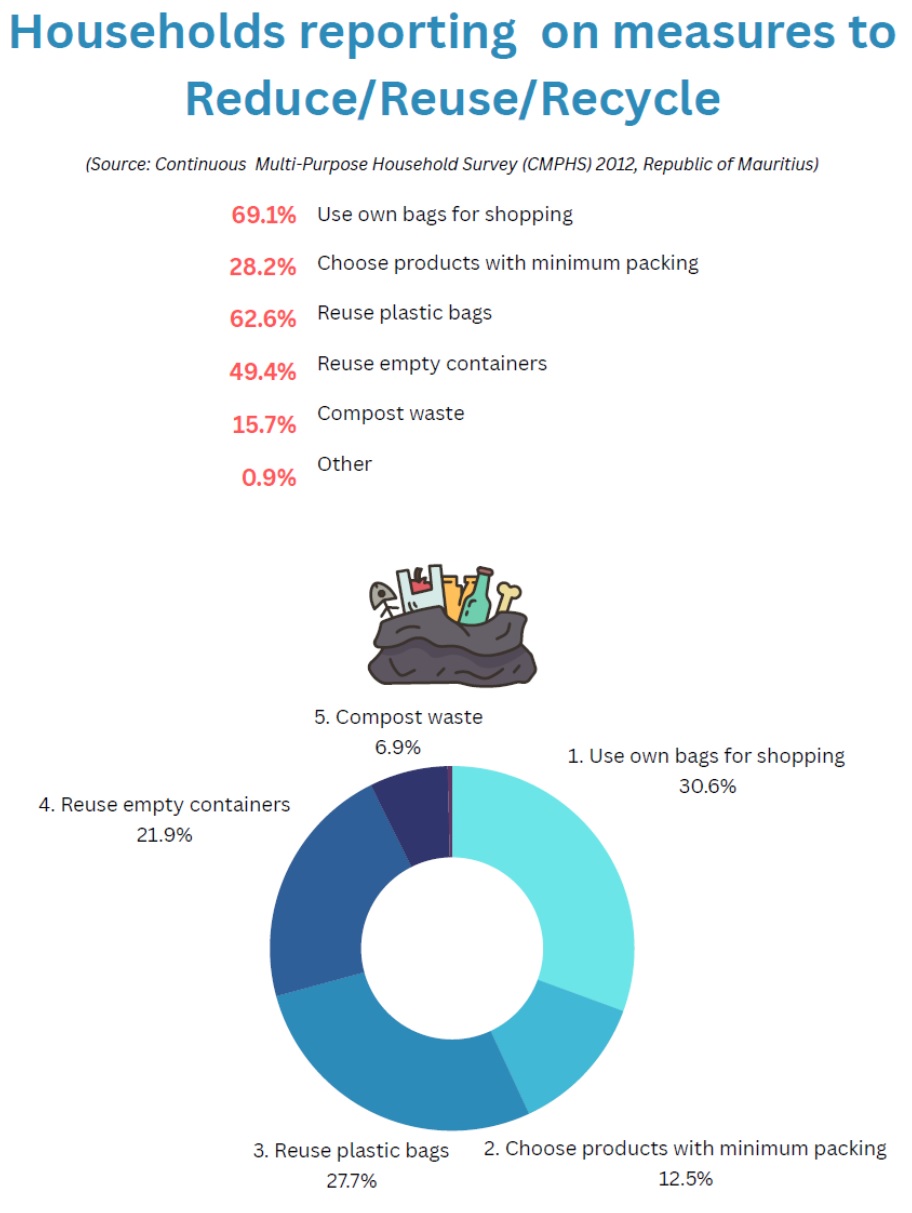 Data Source: Solid Waste Managment Division | 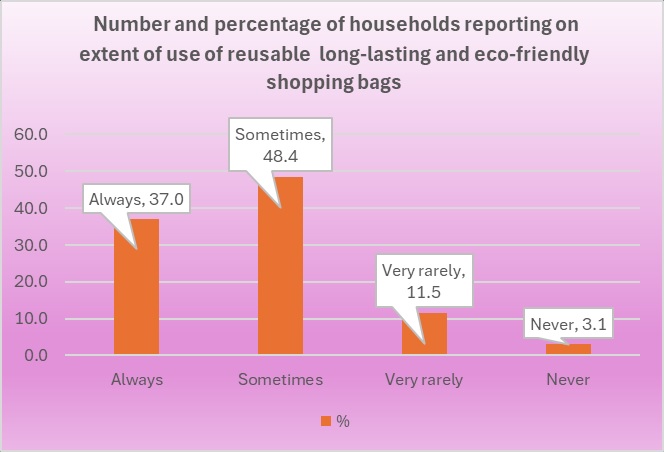 Data Source: Solid Waste Managment Division |
Circular Economy & Household Expenditure: Insights from HBS 2023The Household Budget Survey (HBS) 2023 offers a fresh empirical foundation from which a circular economy (CE) lens can be applied to Mauritian household behaviour. While the survey is not explicitly designed for CE analysis, several expenditure patterns and shifts are relevant for thinking about reuse, repair, shared services, waste recovery, and sustainable consumption. Key Consumption Trends in 2023 (source: Statistics Mauritius)
These trends suggest intensifying consumption pressures, growing service costs, and expanding demand for maintenance and mobility—each of which intersects with CE strategies. CE-Relevant Insights & Opportunities1. Repair, Maintenance & Extended UseThe rise in spending on vehicle repair signals a latent demand for maintenance, refurbishment, and service models. Strengthening the ecosystem of repair shops, incentivising spare-parts manufacturing, and promoting “right to repair” norms can help shift consumption from disposal to repair. 2. Shared Mobility & Sustainable TransportTransport is a large and rising share of household budgets. Encouraging shared mobility, carpooling, micro-mobility, or better public transit can reduce reliance on personal ownership, lower costs, and minimise resource use per person. Given that transport emissions count for nearly half of final energy use in Mauritius, interventions in mobility have amplified impact. (Soomauroo et al, 2023) 3. Food, Waste & Circular Food SystemsFood expenditure remains a dominant category. Interventions like food waste reduction, composting, valorisation of by-products, and promotion of local circular agro-processing can help close loops.
4. Product Lifespans, Second-hand Markets & UpcyclingWhile HBS doesn’t currently isolate second-hand or recycled-product expenditure, the shift in durable goods ownership and maintenance suggests potential for reuse, upcycled products, and second-hand markets. A future survey module could explicitly capture these. 5. Enabling Policy & Institutional Measures
|