

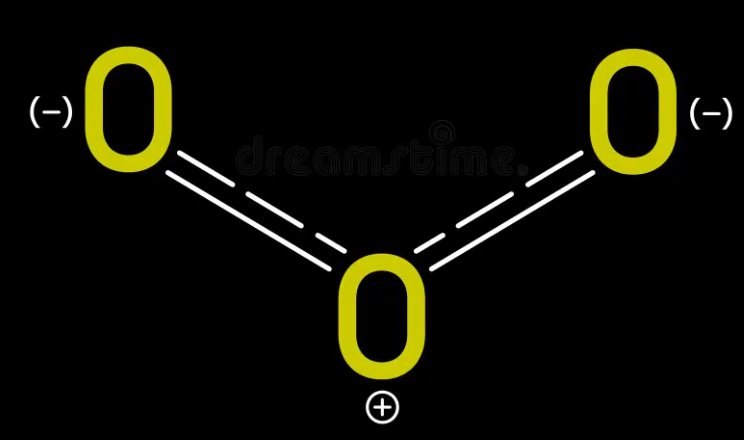
 Ozone, a molecule composed of three oxygen atoms (O3), plays a dual role in Earth's atmosphere. It is both a protective shield in the stratosphere and a harmful pollutant at ground level.
| High above the Earth, the ozone layer serves as a critical shield, protecting life from the sun's harmful ultraviolet radiation. Discover the role of chlorofluorocarbons (CFCs) in the formation of the ozone hole, and explore how the 1989 Montreal Protocol was implemented to halt ozone depletion (watch this video). |
Pre-Industrial (Ground Level) Ozone | |
Understanding pre-industrial ozone levels is important for several key reasons: Baseline Measurements: Knowing the pre-industrial levels of ozone provides a baseline against which to measure the increase due to human activities. This helps in assessing the extent of anthropogenic impacts on the atmosphere and how significantly we have altered natural systems. Climate Change Studies: Ozone is a greenhouse gas and plays a significant role in climate dynamics. By understanding its concentration before industrial influences, scientists can better quantify how much ozone contributes to modern climate change and predict future climate scenarios with greater accuracy. Air Quality and Health: Elevated ozone levels are linked to various health problems, including respiratory issues and cardiovascular diseases. Knowing natural ozone levels helps determine the additional risk posed by current concentrations, guiding public health policies and air quality standards. Environmental Policies and Regulations: With a clear picture of how human activities have altered ozone levels, policymakers can devise more effective strategies and regulations to control emissions of ozone precursors, like volatile organic compounds (VOCs) and nitrogen oxides (NOx). Ecological Impact Assessments: Elevated ozone levels can be harmful to vegetation and ecosystems. Understanding pre-industrial levels allows ecologists to assess the degree of damage and stress on plant life and ecosystems, contributing to conservation strategies. | Ozone measurements made using Schonbein's method during the late nineteenth and early twentieth centuries have been examined and converted to modern units by Pavelin et al (1999). Figure below shows the pre-industrial ozone level for Mauritius. Estimates suggest that global background levels of surface ozone were about 5-10 parts per billion (ppb), whereas modern levels can be as high as 40 to 60 ppb in many industrialized areas . 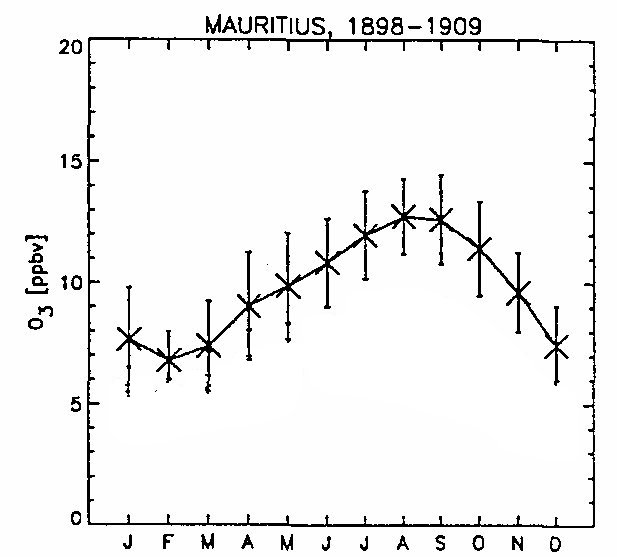 Pre-Industrial Ozone Levels (corrected, average monthly) [source: Pavelin et al. (1999)] |