1. Collaboration and Objectives:National and local governments in Mauritius, in collaboration with local, regional, and international organizations, are actively involved in efforts to reduce disaster risks, respond to emergencies, recover from disasters, and bolster resilience against hazards influenced by climate change.
All Government and Private Institutions
Academic and Research Institutions
Community and Civil Society- Local Community Leaders: Vital in grassroots level disaster preparedness and response efforts.
- Volunteer Groups: Assist in disaster preparedness drills and in providing aid during and after disasters.
- Resident Associations: Engage with local government and NGOs to ensure that community needs are met in disaster planning and response.
- Mauritius Red Cross Society; The Mauritius Red Cross Society (MRCS) participates in simulations organised in coordination with the local authorities.
Regional and International Donors'
Regional Organisations:- Indian Ocean Rim Association (IORA): Facilitates cooperation and strategic partnerships among Indian Ocean states to enhance economic and regional development, including disaster resilience initiatives.
- Indian Ocean Regional Intervention Platform or PIROI: Carries out disaster preparedness and response actions by training emergency response teams and pre-positioning equipment, supporting capacity development of the region’s Red Cross and Red Crescent National Societies, raising risk awareness, and strengthening communities’ capacities.
- Japan International Cooperation Agency (JICA): Provides aid and technical cooperation to enhance disaster management capacities and infrastructure development in the region.
- Southern African Development Community (SADC): Works on regional integration and poverty eradication through economic development and ensuring disaster preparedness and response mechanisms.
Indian Ocean Commission (IOC): Strengthens regional cooperation and sustainable development in the Indian Ocean, focusing on environmental sustainability and disaster risk reduction. - French Development Agency (AFD): Supports projects that promote sustainable development and resilience to climate change and natural disasters in the region.
International Organisations:
- United Nations Resident Coordinator's Office (UNRCO): Coordinates the UN's humanitarian and developmental efforts, including disaster risk management and resilience building in affected countries.
- United Nations Office for Disaster Risk Reduction (UNDRR): Provides frameworks and support for disaster risk reduction strategies worldwide, aiming to substantially reduce disaster risk and losses.
- World Bank (WB): Offers financial support and expertise for infrastructure projects that enhance disaster resilience and sustainable development in vulnerable regions.
- Coalition for Disaster Resilient Infrastructure (CDRI): Promotes the resilience of new and existing infrastructure systems to climate and disaster risks, supporting sustainable development.
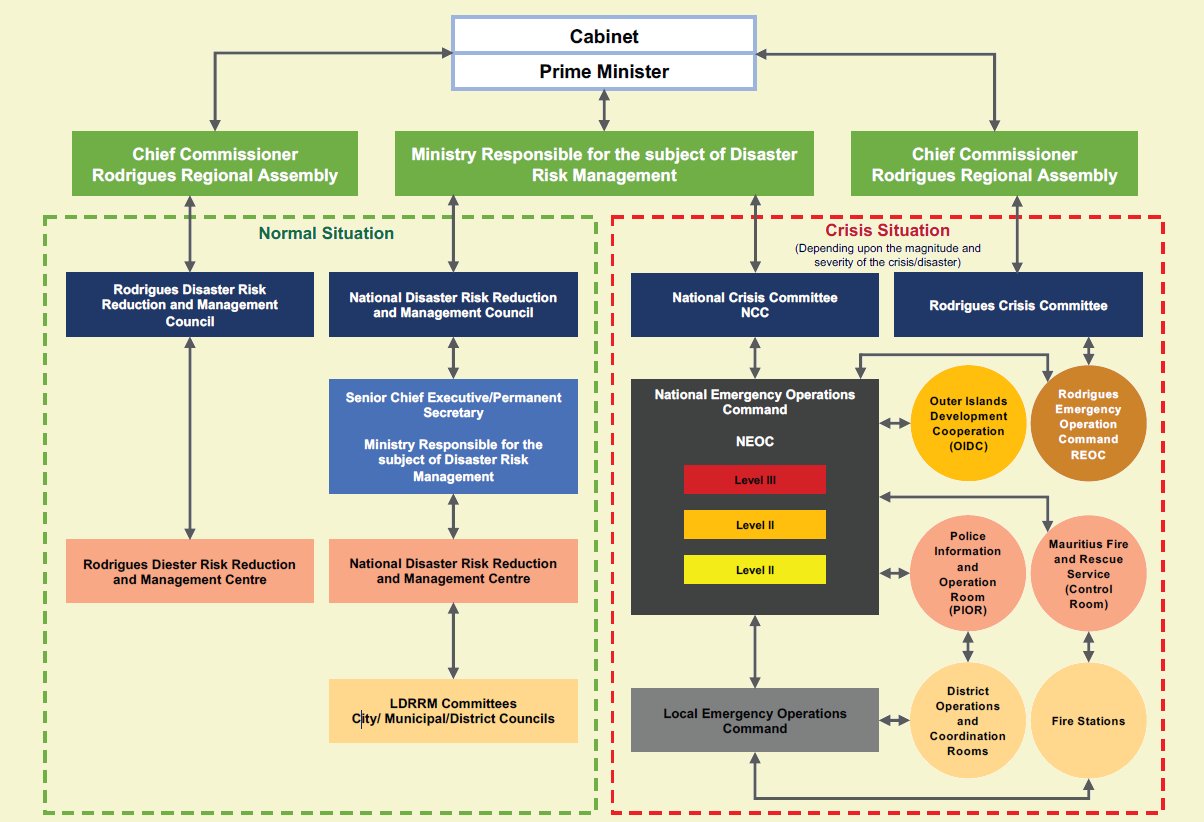
2. National Coordination Framework:- Primary Coordinating Body: The National Disaster Risk Reduction and Management Centre (NDRRMC) serves as the focal point for disaster management activities.
- Supporting Entities: Includes the National Crisis Committee, National Emergency Operations Command, and Local Emergency Operations Commands.
- DRRM Architecture: Illustrated in Figure below, detailing the structure for disaster risk reduction and management.
3. Climate Change Specific Agencies:- Post-2020 Initiatives: Post the Climate Change Act of 2020, key agencies such as the Department of Climate Change, Inter-Ministerial Council on Climate Change, and Climate Change Committee were established.
- Parent Ministry: These agencies fall under the Ministry of Environment, Solid Waste Management, and Climate Change.
4. Prime Minister’s Office:- Supervisory Role: Oversees the NDRRMC and Mauritius Meteorological Services
- Responsibilities of the NDRRMC, NEOC, LEOC: see NDRRMC Act 2016
-
5. Establishment and Oversight:- NDRRMC Formation: Established in October 2013 by a Cabinet decision.
- Governing Council: Operates under the guidance of the National Disaster Risk Reduction and Management Council, ensuring a coordinated approach to planning, organizing, coordinating, and monitoring DRRM activities.
| | National Disaster Risk Reduction & Management Centre (NDRRMC) The National Disaster Risk Reduction and Management Centre (NDRRMC) was established in August 2013 by Cabinet decision. The NDRRMC collaborates with all relevant stakeholders so that disaster risk reduction is an integral component of sustainable development policies and plans. Elements to include land use planning, natural resource management, social planning, building codes, economic and sectoral policies. The NDRRMC also aims to assist and support stakeholders in developing DRRM education, training and research programmes with the ultimate goal of creating a culture of resilience for the country. At the district and municipal levels, local Disaster Risk Reduction Committees have been established, with Local Disaster Management Coordinators appointed. These Coordinators work directly with the NDRRMC, and facilitate the local disaster risk reduction and management activities undertaken by the Local Committees. Normal Situation The NDRRMC is the operational and coordinating body responsible for implementing the national policy for DRRM, and is overseen by the Disaster Risk Reduction and Management Council, chaired by the Minister responsible for Disaster Management. Local Disaster Risk Reduction and Management Committee (LDRRMC) — LDRRMCs exist at the level of districts, cities, and municipalities. LDRRMCs follow the guidance of the National DRRM Council. DRRMCs are at the forefront of risk reduction and management and directly engage in efforts with at-risk populations through planning, drills, and other activities. Crisis Situation The management of active disasters or other crises operates on a three-tier system: National Crisis Committee (NCC) at the Ministerial level: This Committee meets before, during and after crisis situations to take decisive and timely and effective actions in crisis situations through the National Emergency Operations Command to prevent loss of life. National Emergency Operations Command (NEOC) at the National level: NEOC coordinates and monitors all response and recovery activities. The NEOC is be a multi-agency with members from the public and private sectors and report to the National Crisis Committee. Local Emergency Operations Command (LEOC) at Municipal or District Council levels: LEOCs report to the NEOC and likewise include multi-agency stakeholders. Contact Details - National Disaster Risk Reduction and Management Centre
- Corner Louis Pasteur, Sir Virgil Naz and Eugene Laurent Streets,
- 6th Floor, Citadelle Mall,
- Port Louis, Mauritius
- Phone: (+230) 207 3900
- Fax: (+230) 207 3927
- Email: disaster@govmu.org
- Website: https://ndrrmc.govmu.org
Facebook: nationaldisastermauritius
DRRM Structures in the Outer Islands
RODRIGUES ISLAND — The RDRRMC is responsible for planning, coordinating, and monitoring DRRM activities on Rodrigues. The Rodrigues Crisis Committee (RCC) oversees the work of the Rodrigues Emergency Operations Command (REOC). For crises affecting Rodrigues, the NEOC works directly with the REOC. The same sequence of monitoring and activation used for the NEOC exists for the REOC. The REOC is supported by elements of the Police Force and Fire and Rescue Service based on Rodrigues.
AGALEGA AND CARGADOS CARAJOS SHOALS (ST. BRANDON) — For crises affecting Agalega and Cargados Carajos Shoals (St. Brandon), the NEOC works directly with the OIDC.
|