
The Republic of Mauritius Voluntary National Review (VNR) 2024 addresses SDG 13: Climate Action, focusing on taking urgent action to combat climate change and its impacts. Mauritius’ commitments to resilience and green strategies provide a clear foundation for its climate efforts.
SDG 13: Climate Action in the Mauritius Voluntary National Review 2024
Key Achievements
Climate Commitments:
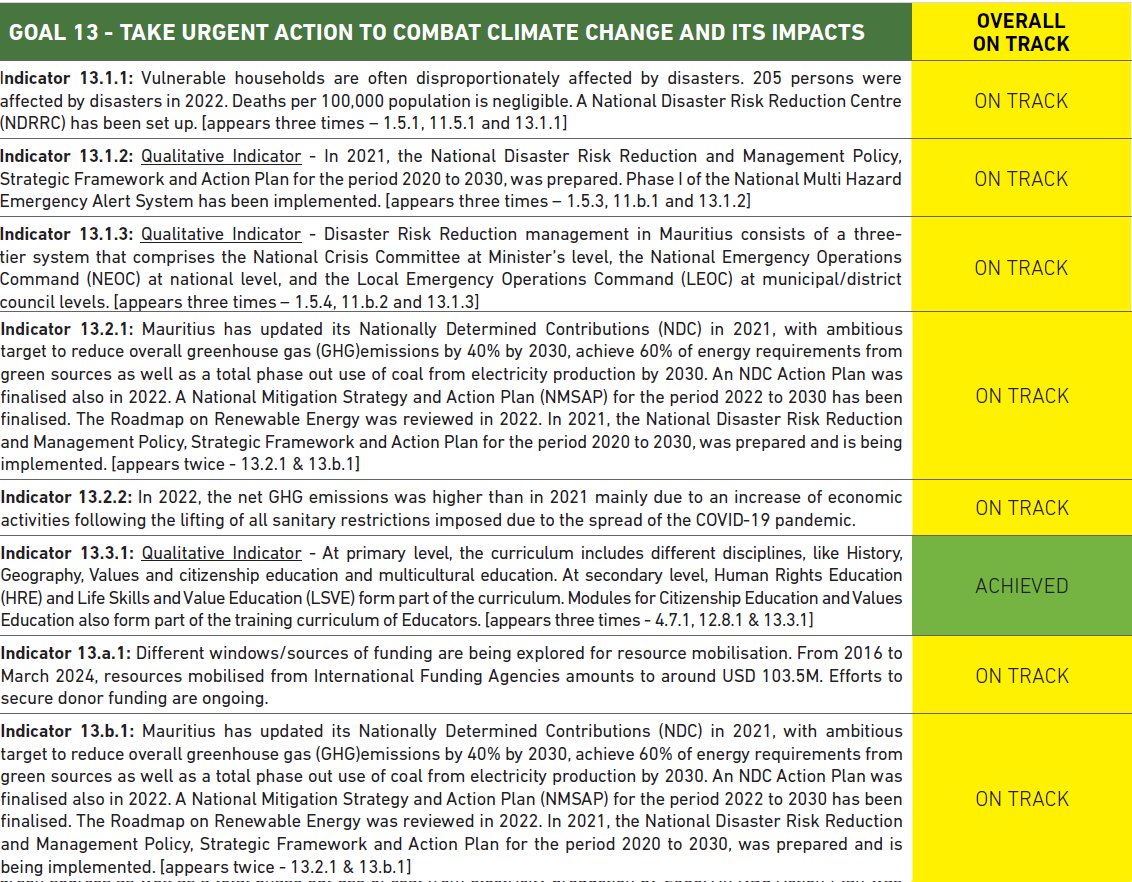
Under the Paris Agreement, Mauritius aims to reduce greenhouse gas (GHG) emissions by 40% by 2030, as outlined in its revised Nationally Determined Contributions (NDCs).
Plans to achieve 60% of energy from green sources and phase out coal in electricity generation by 2030 reflect strong climate mitigation efforts.
Adaptation Measures:
The Land Drainage Masterplan addresses flooding risks from extreme weather, enhancing community resilience.
Nature-based solutions, such as mangrove planting, coral farming, and seagrass mapping, bolster adaptation and protect ecosystems.
Economic and Policy Support:
Investments of USD 2.3 billion from the government (35% of the USD 6.5 billion NDC cost) demonstrate national commitment, with the remainder sought from international partners.
Economic recovery efforts post-COVID prioritize sustainability, aligning with climate goals.
Challenges
Climate Vulnerability: Frequent cyclones, flash floods, and rising sea levels threaten infrastructure, livelihoods, and ecosystems.
Funding Gaps: The USD 4.2 billion shortfall for NDC implementation relies on external support, posing a financial challenge.
Opportunities and Future Outlook
Global Partnerships: Strengthened international cooperation can unlock funding and expertise for climate initiatives.
Innovation: Leveraging technology and research can enhance mitigation and adaptation strategies.
Resilience Building: Expanding nature-based and infrastructural solutions can mitigate future climate risks.
Conclusion
Mauritius advances SDG 13 with ambitious emission reduction targets, adaptive infrastructure, and nature-based solutions. Climate vulnerabilities and funding needs remain significant hurdles, but opportunities in partnerships and innovation support its climate action trajectory.