
The Republic of Mauritius Voluntary National Review (VNR) 2024 details progress under SDG 2: Zero Hunger, focusing on enhancing food security, improving nutrition, and promoting sustainable agriculture. The report highlights Mauritius' efforts to transition its agricultural sector toward resilience and sustainability while addressing climate change and external dependencies.

SDG 2: Zero Hunger in the Mauritius Voluntary National Review 2024
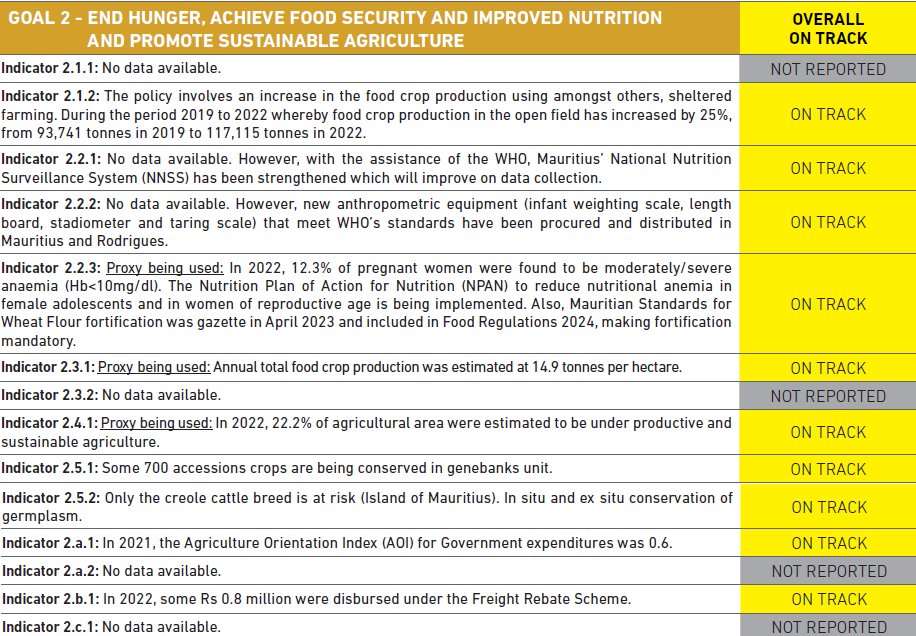
Key Achievements
1. Agricultural Contribution and Land Use:
- In 2023, agriculture contributed 4.3% to GDP, with 22.2% of total land area under sustainable practices, including sugarcane and food crops.
- In 2022, 7,865 hectares of food crops were harvested, producing 117,115 tonnes in open fields (a 25% increase from 93,741 tonnes in 2019) and 9,237 tonnes under protected cultures (a 51.2% rise from 6,111 tonnes in 2021).
2. Sustainable Farming Transition:
- Mauritius is shifting from traditional open-field farming to sheltered systems like hydroponics, aquaponics, and vertical farming, with 2,000 sheltered farm units covering 800 hectares by February 2024, producing crops such as tomatoes (8,086 tonnes in 2023).
- The Food and Agricultural Research and Extension Institute (FAREI) developed the Mauritian Standard on Good Agricultural Practices (MauriGAP), aligning with Global Gap standards, with training and certification provided by the Mauritian Standard Bureau (MSB).
3. Support for Local Production:
- Financial assistance, subsidies for inputs, and equipment have boosted non-sugar crop production. The National Wholesale Market, established in 2023, facilitates affordable trading of local vegetables and fruits.
- Organic farming is encouraged, with initiatives like seaweed compost to reduce reliance on imported fertilizers.
4. Policy and Innovation:
- The Use of Pesticides Act 2018 regulates pesticide use to minimize health and environmental risks.
- A 2022 feasibility study, funded by the Joint SDG Fund, explored seaweed as a fertilizer alternative.
- The Smart Agriculture project (2018–2022), supported by the Agence française de développement (AFD), European Union, and other partners, implemented agro-ecological principles on 20 hectares across 13 growers.
Challenges
- External Dependency: Staple foods like rice, wheat flour, and cereals are mostly imported, increasing vulnerability to global supply shocks.
- Climate Change: Adverse weather impacts agricultural resilience, necessitating adaptive measures like sheltered farming.
Opportunities and Future Outlook
- Enhanced Resilience: Sheltered farming and sustainable practices aim to mitigate climate effects and boost production capacity.
- Eco-Friendly Shift: Organic methods and reduced chemical use align with safer, nutritious food production goals.
- Regional Collaboration: Partnerships with institutions like CIRAD and MRIC foster innovation and knowledge-sharing.
Conclusion
Mauritius has advanced SDG 2 by increasing local food production, adopting sustainable farming practices, and supporting farmers through policy and innovation. While challenges like import reliance and climate vulnerability persist, ongoing efforts in sheltered farming and eco-friendly agriculture position Mauritius to strengthen food security and resilience.