Sea level rise poses a significant threat to low-lying regions of small islands and atolls. Studies show that global mean sea level rise rates are likely accelerating due to climate change. Due to the slow response of sea levels to global warming, sea levels will continue to rise for a long time even after greenhouse gas emissions are reduced. Consequently, regardless of any changes in storm surge characteristics, higher storm surges are expected as sea levels continue to increase.
Sea Level Changes
Storm tides, which result from the combined effects of sea level rise (SLR), astronomical tides, and storm surges from tropical cyclones, pose serious risks to coastal areas. They often lead to flooding and extensive damage to property and infrastructure. A recent example is Cyclone Belal, which struck Mauritius in January 2024 during high tide, causing widespread damage to infrastructure.
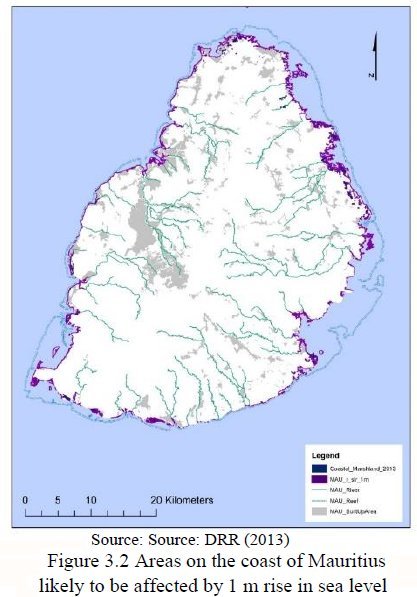
In Mauritius, the impacts of SLR are already evident, most visibly through accelerated beach erosion. Surveys have shown that about 17% of beaches—roughly 13 km—are affected by erosion (JICA, 2015). Coastal inundation is also projected to worsen, increasing threats to settlements and infrastructure. By 2070, an estimated 12.2 km² of built-up land could be permanently inundated, with infrastructure damage costs reaching around USD 1.4 billion (JICA, 2015).
Rising Sea Levels Around Mauritius
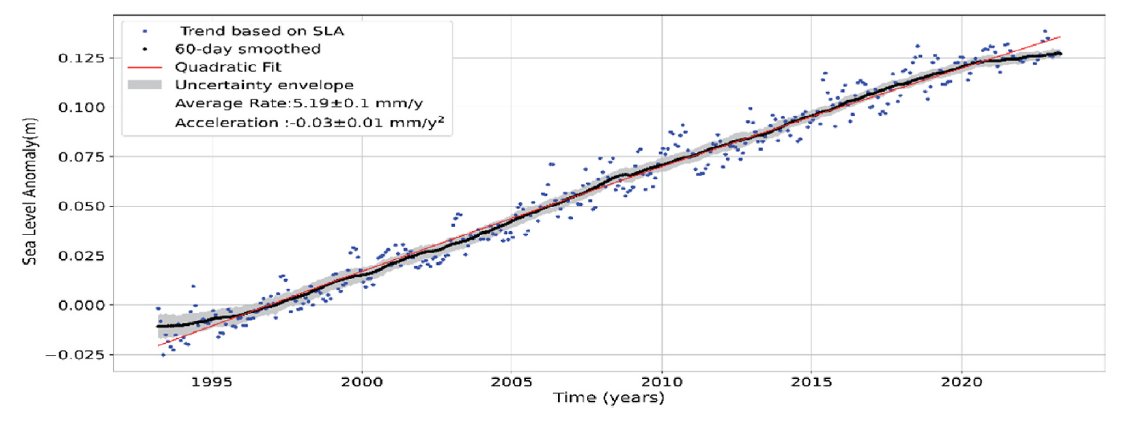
This graph shows how sea levels around Mauritius have changed from 1993 to 2022 (Sadien M. et al, 2024)
* Over the past 30 years, sea levels have risen by about 12–13 cm.
* On average, the sea has been rising by around 5 mm each year – faster than the global average.
* The black line shows the long-term trend, while the small dots represent monthly variations.
* Even though the curve suggests a very small slowing down, the overall message is clear: sea levels are steadily going up.
Why this matters
Rising seas increase the risk of:
* Coastal erosion (loss of beaches and shorelines)
* Flooding during storms and high tides
* Saltwater intrusion into freshwater supplies
* Greater threats to coastal communities, ecosystems, and infrastructure
Mauritius, as a small island nation, is highly vulnerable to these changes, making climate adaptation and coastal protection urgent priorities.
Projections and Policy Recommendations
Future climate projections indicate that by 2100, sea levels could rise by approximately 0.43 m under RCP 2.6 and 0.84 m under RCP 8.5 (Oppenheimer et al. , 2019). In response, Mauritius must develop strategic policies, programmes, and projects, and mobilize adequate resources to mitigate and adapt to these anticipated changes.
SLA trend for Mauritius.
Seasonal signals are removed, and the time series is 2-month-filtered. The uncertainty envelope (shaded grey area) is given a 90 % confidence level as for the trend and acceleration uncertainties indicated in the legend box.
Average rate of sea level rise:5.19 ± 0.1 mm/year, which is higher than the global average (~3.3 mm/year over the same period).
Acceleration:-0.03 ± 0.01 mm/year, suggesting a very slight deceleration in the rate of sea level rise, though within uncertainty limits this may not be statistically significant.
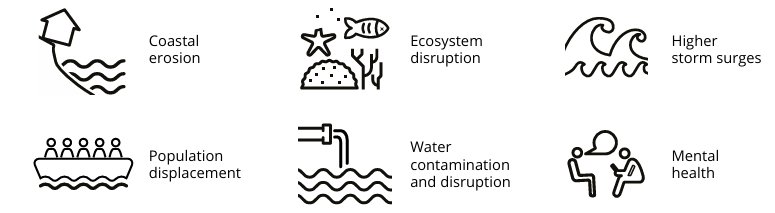
Potential impacts of sea level rise (SLR) on Mauritius
and more…
Coastal Erosion: Accelerated erosion can lead to significant loss of beaches and land, impacting both the environment and local economies reliant on tourism. Intensified coastal erosion has resulted in a reduction of beach widths by up to 20 meters in certain areas, with 17% of Mauritius’s coastline, eroding between 1967 and 2012 (JICA). This erosion not only threatens the natural habitat of marine species and coral reefs but also poses significant risks to the tourism industry, potentially eroding about $50 million in sector value by 2050 (INDC, 2015).
Flooding: Increased sea levels will cause more frequent and severe coastal flooding, damaging infrastructure and properties.
Saltwater Intrusion: Rising sea levels will cause saltwater to encroach into freshwater resources, affecting drinking water supplies and agriculture.
Habitat Loss: Key habitats such as mangroves and coral reefs will be severely impacted, disrupting local ecosystems and the species that depend on them.
Impact on Fisheries: Changes in sea conditions and habitat will adversely affect marine life and fisheries, which are vital for local livelihoods.
Economic Impacts: The tourism sector may suffer due to the loss of natural attractions and beaches, and increased costs for infrastructure resilience could strain economic resources. The observable shrinkage of beach areas adversely affects the tourism and hospitality sectors, which are pivotal to the nation's economy, contributing nearly 24% to the GDP and accounting for 22% of employment.
Health Risks: There could be an increase in waterborne diseases due to flooding and water contamination, impacting public health.
Cultural and Heritage Loss: Important cultural sites near the coast are at risk of being damaged or lost due to erosion and flooding.
Ecosystem Disruption: Beyond specific habitat loss, broader ecosystem imbalances can occur, affecting biodiversity and ecosystem services.
Population Displacement: As areas become uninhabitable due to SLR, there may be internal and external displacement of populations seeking safer habitats.
Water Contamination and Disruption: Flooding and saltwater intrusion can lead to widespread issues with water quality, affecting both human consumption and agricultural use.
Mental Health: The stresses associated with displacement, property loss, and lifestyle changes due to SLR can lead to mental health challenges for affected populations.
These factors highlight the need for robust, multi-sectoral adaptation strategies to protect and prepare Mauritius for the long-term challenges posed by sea level rise.