
Projects by the Ministry of Agro-Industry, Food Security, Blue Economy and Fisheries (Blue Economy and Fisheries)
(i) Component 1: Enhancement of food security and reduction of risks from natural disasters through the restoration of degraded reefs in Mauritius; (ii) Component 2: Enhancement of food security and reduction of risks from natural disasters through the restoration of degraded reefs in Seychelles; and (iii) Component 3: Knowledge management and sharing, training and sensitisation to build regional capacity for sustainable reef restoration. Coral reef restoration work in Mauritius is focused on two Marine Protected Areas, namely: (i) Blue Bay Marine Park; and (ii) South East Marine Protected Area (SEMPA) in Rodrigues. (B) Funding The project is funded through a grant of USD 10 million from the Adaptation Fund. In addition, a Cost Sharing Agreement was signed between the UNDP and the then Ministry of Blue Economy, Marine Resources, Fisheries and Shipping in September 2020 for MUR 59 million (approx. USD 1.4 million) for the setting up of land-based nursery at Mauritius Oceanography Institute (MOI) (for asexual propagation of corals) and Albion Fisheries and Research Centre (AFRC) (for sexual propagation of corals) and installation of a seawater pump at MOI. Under the project, 3 NGOs (2 in Mauritius and 1 in Rodrigues) have been awarded contracts to train community members in coral farming techniques. A total of 3.2 hectares (2.5 Ha in BBMP and 0.7 Ha in SEMPA, Rodrigues) of degraded coral reefs would be rehabilitated in the Republic of Mauritius. Moreover, land-based coral nurseries facilities would be set up in the AFRC and MOI. Coral restoration through sexual reproduction would be carried out in the land-based nurseries of AFRC and thermal-resistant and rare coral species would be cultured in the land-based nurseries of the MOI. Two out-planting sites (OP), OP 1 and OP 2 have been earmarked for restoration within the Blue Bay Marine Park. Nurseries grown corals transplantation has started since May 2025 and it is expected that a total of about 8000 nurseries grown will be transplanted at the 2 out-planting sites. As at date, about 1.5 ha of degraded coral reefs has already been restored within the Blue Bay Marine Park under the project. Project: Assistance scheme for coral farming and fish breeding programme The project was funded to the tune of approximately Rs 25 Million by the National Environment and Climate Change Fund (NECCF) and it ended in February 2026. The project was implemented by the Albion Fisheries Research Centre (AFRC) in collaboration with the Mauritius Oceanography Institute (MOI) at localities namely, Grand Gaube, Poudre d’Or, Poste de Flacq, Trou d’Eau Douce, Quatre Soeurs, Bel Ombre, Rivière Noire and Tamarin. Four table coral nurseries and four multi-layered rope nurseries have been established at Le Morne, Bel Ombre, Belle Mare and Grand Gaube, respectively. Additionally, 4 coral gardens have been created at Grand Gaube, Le Morne, Bel Ombre and Belle Mare under the Assistance Scheme for Coral Farming and Fish Breeding Project. 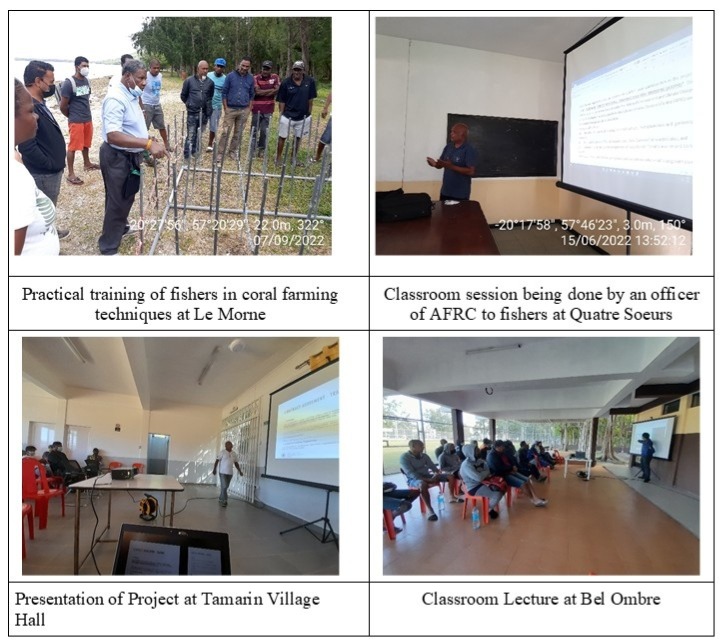 (Source: Ministry of Agro- Industry, Food Security, Blue Economy and Fisheries (Blue Economy and Fisheries)) Projects by Food and Agriculture Organisation:
Protected Endemic Sanctuaries:
Projects by the Mauritius Oceanography Institute
The marine ecosystem supports many economically important industries including fisheries, tourism and pharmaceuticals. However, the marine environment is increasingly threatened by pollution, overexploitation and climatic changes. Such threats accelerate the loss of marine biodiversity, urging the need to inventory marine organisms before they become extinct. Although inventory has been traditionally carried out using morphological features, the limitations inherent in morphology-based identification systems and the dwindling pool of taxonomists have signalled the need for a new approach to taxon recognition. Today, DNA technology has become an effective tool for species identification and the concept of DNA barcoding has gained worldwide popularity. The MOI has initiated this DNA-barcoding project since 2010, targeting numerous marine taxa. Following the successful application of a methodology combining conventional taxonomy and the more contemporary DNA-based approach for the identification and validation of commercial fishes, sea cucumbers and marine molluscs sampled from Mauritius waters, marine crustaceans were next targeted. The general objectives of the project are to (i) identify marine living resources (fish, sea cucumbers, molluscs, crustaceans, etc.) using taxonomy and DNA-based techniques (ii) populate MOI’s online marine diversity and genetic database and (iii) publish posters and field guides (use by various stakeholders including aquaculture investors). 2. Restoring Marine Ecosystem Services by Rehabilitating Coral Reefs to Meet a Changing Climate Future (AF-UNDP funded project) Corals that survive bleaching events provide a critical opportunity to restore degraded reefs and maintain their ecological functions. However, the rapid pace at which climate change is negatively affecting coral reefs means that conservation measures alone are no longer sufficient to ensure that reefs remain functional and continue to deliver essential ecosystem services to coastal communities, including food security, shoreline protection from storms and erosion, and resilience to sea-level rise. Active intervention through coral reef restoration, particularly using thermally tolerant coral species or genotypes, is therefore required to enhance reef resilience and facilitate adaptation to ongoing and future climate change. This project seeks to increase climate resilience in the Republic of Mauritius and the Republic of Seychelles by implementing coral reef restoration using thermally tolerant corals as a climate change adaptation measure. The project benefits both countries through on-the-ground coral restoration activities, complemented by a regional capacity-building programme and structured knowledge exchange to strengthen technical expertise and promote best practices in coral reef restoration and climate adaptation. 3. Bioprospecting of Mauritius waters Marine sponges have raised pharmaceutical interest since the early 1950’s and these invertebrates are excellent sources of bioactive natural products (NPs). They are the oldest multicellular organisms. Together with their associated microorganisms, they are a unique source of biologically active NPs and have become a focus area of research for the treatment of cancer, diabetes and neurological disorders that affect millions of people worldwide. A wide array of activities has been attributed to the remarkable chemical diversity of marine sponges, including anti-inflammatory, antitumor, antiviral, antimalarial, antibiotic, and antifouling activities. An example of a marine-to-clinic pipeline is Eribulin, a scaffold derived from halichondrin B (a potent cytotoxin) of Halichondria okadai, which is used for treating metastatic breast cancer. In 2004, the Mauritius Oceanography Institute (MOI) initiated the project entitled “Bioprospecting of Mauritius Waters” aimed at investigating the therapeutic potential of sponge-derived extracts/bioactive compounds from Mauritius Waters. In 2007, through the initial collaboration with the National Centre for Scientific Research (CNRS), a novel class of scyllo-inositol glycolipids, Dragmacinosides (1 & 2) was isolated from the sponge Dragmacidon durissima. Scyllo-inositol has been investigated for the treatment of Alzheimer's disease (AD) and in 2012, the isolation of two new alkaloids (Donnazoles A and B) was reported from the sponge Axinella sp. Over the years, the MOI has compiled a list of taxonomically identified marine sponges as well as scientific publications attesting to the biological activity of sponge extracts against various types of diseases such as cancer, Alzheimer’s and diabetes. Some extracts displayed promising activities and can be further purified to isolate the bioactive compounds. The MOI has also identified bioactive compounds such as jaspamide from Jaspis sp, petrosynol from Petrosia sp and ?-sitosterol from Epipolasis sp. The potential uncovered within Mauritius Waters has encouraged further investigation into sponge species for discovering novel bioactive compounds with therapeutic properties and to strengthen MOI’s research capacity in marine drug development. (Source: Beedasee et al., 2012 Cytotoxic activities of hexane, ethyl acetate and butanol extracts of marine sponges from Mauritian Waters on human cancer cell lines, Environmental Toxicology and Pharmacology, 34(2): 397-408 https://doi.org/10.1016/j.etap.2012.05.013. and Roy et al. 2020 Cytotoxic potential of sponge extracts from Mauritius Waters on human cancer cell lines. Hematol Med Oncol 5: https://doi.org/10.15761/HMO.1000208 ) 4. Valorisation of marine resources of the Indian Ocean: Biopolymers and active biomolecules for biomedical and cosmetic applications In 2019, the Mauritius Oceanography Institute (MOI) in collaboration with the Centre for Biomedical and Biomaterials Research (CBBR), University of Mauritius and CYROI (Cyclotron Réunion Océan Indien) initiated a joint research Higher Education Commission (HEC) funded project entitled “Valorization of marine resources of the Indian Ocean: Biopolymers and active biomolecules for biomedical and cosmetic applications”. The project aimed at screening selected species of marine sponges and seaweeds for bioactive molecules and biomaterials. The profiling of vitamins, minerals and heavy metals in green, red and brown seaweeds extracts, collected from Mauritius and Rodrigues, was carried out. A scientific visit of two staff of the MOI for three weeks at the University of Witwatersrand, South Africa resulted in the biological screening of 20 sponge derived on three cancer cell lines (A172, TERA-1 and DLD-1) and one normal cell line (CCD-18-Co) and screening of selected seaweeds extracts for their potential against diabetes using enzyme-linked immunosorbent assay kit for insulin in RIN5F cells. Additionally, CaCO3 was extracted from Halimeda opuntia, a coralline algae collected from Rodrigues and was used for the synthesis of bio-hydroxyapatite (HAp). Bio-hydroxyapatite as biomaterials, can be used as nano-fibrous scaffolds with a capability of tissue renewal and regeneration. This project has brought together the competencies of three institutions experts in specific areas. Together these three institutions have endeavored to produce a list of active molecules/biomaterials from marine resources of the region and their potential applications. Rodrigues territory was also included as studies in that region are very scarce. These results will allow to have evidence-based data to attract pharma and cosmetic companies. (Source: Bekah et al., 2023 Vitamins, minerals and heavy metals profiling of seaweeds from Mauritius and Rodrigues for food security, Journal of Food Composition and Analysis 115:https://doi.org/10.1016/j.jfca.2022.104909.) 5. Biological survey of Port Mathurin Harbour to detect introduced species With the entry into force of the International Convention for the Control and Management of Ships’ Ballast Water and Sediments (BWM Convention) on 8 September 2017, many countries have enacted national laws and regulations to mitigate the risks associated with the introduction of Invasive Aquatic Species (IAS) through ships’ ballast water. The Government of Mauritius, through the parent Ministry (Shipping Division), has been pursuing the implementation of Ballast Water Management (BWM) practices in line with the 2004 BWM Convention. In this context, the Shipping Division entered into a contractual agreement with the Mauritius Oceanography Institute (MOI) to conduct a Port Biological Baseline Survey (PBBS) in Port Mathurin as part of the development of a comprehensive Ballast Water Management regime. To support this initiative, a targeted approach for the execution of the Port Mathurin Port Biological Baseline Survey was developed with the objective of maximizing the available sampling capacity while generating scientifically robust results. The survey aimed to determine the presence or absence of introduced alien species in Port Mathurin and its adjacent marinas. 6. Port Louis Baseline Survey, Risk Assessment and Ballast Water Management Project Shipping is responsible for the carriage of around 90% of global trade. It is also regarded as a major vector for the introduction of Invasive Aquatic Species (IAS) into aquatic ecosystems through ship hull biofouling, as well as the discharge of ballast water and sediments. Bio-invasions by IAS may pose a significant threat to recipient ecosystems, with potentially harmful consequences for the economy, the environment, and human health. Mauritius, as an important maritime logistics and transshipment hub in the Indian Ocean, is considered a hotspot for both primary and secondary bio-invasions. The Republic of Mauritius established a National Task Force for Ballast Water Management at the level of the parent Ministry (Shipping Division) with the objective of identifying sources of ballast water, compiling relevant information, assessing ballast water volumes, and advising on national policy relating to awareness, control, and surveillance of ballast water. Consequently, the Shipping Division entered into an agreement with the Mauritius Oceanography Institute (MOI) in 2010 to conduct a Port Biological Baseline Survey (PBBS) of the Port Louis harbour area. The project supported the development of a risk-based management system to assist port State control procedures in assessing ballast water carried by visiting international ships and the associated risk of alien species transfer. Furthermore, a comprehensive Port Biological Baseline Survey was carried out in 2012 using, inter alia, diver-based and surface-deployed sampling methods. The primary objective was to determine the presence or absence of Invasive Aquatic Species in Port Louis Harbour. Other projects
|