
Mauritius, being an island nation with unique flora and fauna, has critical conservation priorities. The following best practices and their accompanying case studies highlight Mauritius's proactive and multifaceted approach to biodiversity conservation, which is crucial given its status as a biodiversity hotspot with many unique species and ecosystems:
Biodiversity ConservationCase Study: “Ecosystem-Based Adaptation Implementation” The Critical Ecosystem Partnership Fund (CEPF), a collaboration between entities including l’Agence française de développement (AFD), Conservation International, and the World Bank, focuses on engaging civil society in biodiversity conservation. With support from the Green Climate Fund and the European Union, CEPF is managing a 10-year initiative to promote ecosystem-based adaptation across the Madagascar and Indian Ocean Islands Biodiversity Hotspot, impacting regions such as Madagascar, Comoros, Mauritius, and Seychelles. | ||
| ||
Invasive Species ManagementCase Study: “Control of Invasive Species in Black River Gorges National Park” The park has implemented a programme to eradicate invasive plant species like the Chinese guava, which threatens the native biodiversity. The project includes manual removal and the use of biological control agents, helping to restore native ecosystems. These management actions help restore native flora and improve habitat conditions for endemic wildlife. | ||
Species Reintroduction ProgrammesCase Study: "The Echo Parakeet Success Story" Once considered one of the world's most endangered parrots, the echo parakeet has seen a remarkable recovery thanks to concerted efforts by the Mauritian Wildlife Foundation. The program included captive breeding, habitat restoration, and predator control, which significantly increased their population. | ||
Habitat RestorationCase Study: "Ile aux Aigrettes Nature Reserve Restoration" This small coral island near Mauritius has been transformed into a nature reserve where native vegetation has been replanted, and invasive species have been removed. The reserve now supports a variety of endemic species including the Mauritius Fody and the Pink Pigeon. | ||
Marine Protected AreasCase Study: "Blue Bay Marine Park" Blue Bay Marine Park is one of Mauritius' key marine protected areas, safeguarding coral reefs, mangroves, and seagrasses that are vital for marine biodiversity. The area supports ecotourism practices that educate visitors while conserving marine life.
| ||
Community Engagement in ConservationCase Study: "The Moka Greening Spirit Project" The Green Spirit Club initiative seeks to build a community of well-prepared and empowered citizens dedicated to environmental protection. This community-driven initiative involves local residents in tree planting activities to restore and expand green spaces. This not only enhances urban biodiversity but also fosters a sense of stewardship among the community. More |
| |
Endemic Species GardensCase Study: "Pamplemousses Botanical Garden Medicinal & Spice Corners" The famous Pamplemousses Botanical Garden has dedicated areas for the cultivation and preservation of Mauritius' endemic plant species, serving both as a conservation tool and an educational resource for locals and tourists. | ||
Ecotourism DevelopmentA number of private organisations combines conservation with tourism, focusing on sustainable practices that minimize environmental impacts and promote the conservation of local wildlife. They offer educational tours that raise awareness about the importance of biodiversity. | ||
Research and MonitoringCase Study: "Mauritian Fruit Bat Population Management" Ongoing research and monitoring programs help manage the population of the Mauritian fruit bat, crucial for maintaining ecological balance and preventing overpopulation that can lead to conflicts with agricultural interests. | ||
Public Awareness CampaignsCase Study: "National Biodiversity Campaign" This government-led campaign aims to educate the public on the importance of biodiversity through media, workshops, and school programs. It encourages citizen participation in conservation efforts, fostering a national conservation ethic. | ||

Ministry of Agro-Industry, Food Security, Blue Economy and Fisheries
Best Practice conservation of marine biodiversity
The Blue Bay Marine Park (BBMP) is located in the South East of Mauritius and was proclaimed a National Park under the Wildlife and National Parks Act 1993 in October 1997. It was declared a Marine Protected Area and designated a Marine Park in June 2000 under the Fisheries and Marine Resources Act 1998.
The Blue Bay Marine Park has been recognised as a wetland and as such it has been declared and listed as a Ramsar Site of international importance in January 2008. It extends over an area of 353 hectares (3.5 km2) seaward. The Blue Bay Marine Park has been declared a marine park because it harbours a rich marine biodiversity and ecosystems. Moreover, the BBMP is recognised for its exceptional underwater seascape which consists of luxuriant corals, fishes, sea grasses, macro-algae, molluscs and other marine organisms.
The Blue Bay Marine Park is managed through application of the Fisheries and Marine Resources (Marine Protected Areas) Regulations which came into force in 2001 and amended in 2007. The regulations provide the different tools for the management of the park; namely, (a) Zoning system, (b) Permit system and (c) law enforcement and patrol. Coupled with the above tools, awareness/sensitisation campaigns and research/monitoring are also conducted for the management of the park.
The Blue Bay Marine Park has been demarcated into different specific zones with specific coloured buoys in order to provide protection to critical habitats, ecosystems and ecological processes; to conserve biological diversity, to cater for various permissible activities; and to separate conflicting human activities.
These zones are as follows:
(i) Strict Conservation Zone- Demarcated with green buoys and are meant for conservation of sensitive ecosystems whereby a limited number of recreational activities are permitted such as glass bottom boating, snorkeling and diving. Pole and line fishing from the shore is permitted in Zone B as shown in the map below;
(ii) Conservation Zone- Demarcated with green buoys, whereby limited number of recreational activities are permitted such as glass bottom boating, snorkeling and diving, Pole and line fishing from the shore. Pole and line fishing from the shore is permitted as shown in the map below;
(iii) Ski lane- Demarcated by orange buoys and whereby water skiing is allowed;
(iv) Mooring Zone- Demarcated with white buoys and used for mooring of boats;
(v) Traffic Lane- Demarcated with red and white buoys, which allows entry or passage through the park by a motorised boat (speed limit not exceeding 3 knots);
(vi) Swimming zone - Demarcated by yellow buoys and is the zone designated for swimming No boating and fishing are allowed in the swimming zone; and
(vii) Multiple Use Zone- Designated for a specified range of recreational activities where boating and fishing with lines and basket traps are permitted.
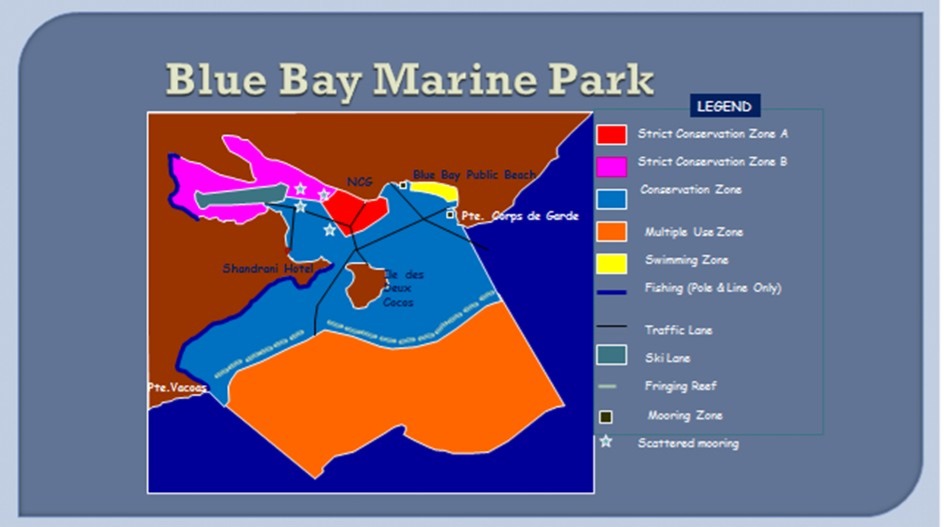
Figure 1: The Blue Bay Marine Park and its designated zones.
(Source: Ministry of Agro-Industry, Food Security, Blue Economy and Fisheries (Blue Economy and Fisheries Division))
Close season for octopus fishery in Mauritius
Due to drastic decrease in octopus catch during the past years, in 2016 the Government proclaimed the Fisheries and Marine Resources (Fishing of Octopus) Regulations which stipulated that “No person shall fish – (a) any undersized octopus; any octopus from 15 August to 15 October in a year.” This two-month (15 August to 15 October) closed fishing season for octopus, has been put in place for Mauritius and St Brandon. The aim of this closure is to allow female octopi to lay eggs at the peak season, hence, increase the opportunity to get more juvenile octopus for stock replenishment as well as to allow maturation of adult octopi.
Furthermore, in 2020, in order to further strengthen the protection and conservation of the octopus and to make the octopus fishery sustainable, the Government introduced two closed seasons in one-calendar year for fishing of octopus, starting 15 August and ending on 15 October of each year to allow mature female octopuses to spawn and replenish the stock, followed by a second closure (as from 2020) from the 15 January till 15 March of each year to allow new juvenile octopus to attain maturity size. Moreover, the authorised minimum landing size for octopus is 7 cm mantle length.
(Source: Ministry of Agro-Industry, Food Security, Blue Economy and Fisheries (Blue Economy and Fisheries)