
Proper medical waste management is crucial for protecting public health and the environment in Mauritius. By strengthening regulatory frameworks, investing in modern waste treatment technologies, and raising awareness among stakeholders, the country can ensure a safer and more sustainable approach to handling medical waste.
Medical waste, also known as healthcare waste, comprises all waste materials generated at healthcare facilities, such as hospitals, clinics, laboratories, and pharmacies. These wastes can pose serious health risks if not managed properly, as they may contain infectious agents, hazardous chemicals, and pharmaceuticals. Proper containment, handling, and disposal of medical waste are crucial, as its microbial load—and therefore its potential to cause infection—is significantly higher than that of household waste. An essential part of biomedical waste management is the triage and classification of waste types. Infectious waste should be treated through incineration, whereas general waste may be safely disposed of by burial or landfilling.
In Mauritius, the management of medical waste is a critical issue due to the country's limited land resources and the potential environmental and health hazards associated with improper disposal.
Types of Medical Waste
Medical waste in Mauritius can be classified into the following categories:
- Infectious Waste – Includes materials contaminated with pathogens such as used bandages, swabs, cultures, and discarded medical instruments.
- Pathological Waste – Comprises human tissues, organs, and fluids from surgeries or autopsies.
- Sharps Waste – Includes needles, syringes, scalpels, and other sharp medical instruments that may cause injuries and transmit diseases.
- Pharmaceutical Waste – Expired or unused medications, vaccines, and drugs that need proper disposal to prevent contamination.
- Chemical Waste – Includes disinfectants, laboratory reagents, and other toxic chemicals used in medical facilities.
- Radioactive Waste – Generated from medical treatments involving radioactive substances such as radiotherapy.
- General Waste – Non-hazardous waste such as paper, plastics, and packaging materials from medical facilities.
There are other types of non-infectious wastes hazardous chemical wastes, gaseous wastes and electronic wastes like batteries that can be generated at healthcare facilities.
Current Medical Waste Management System in Mauritius
As per the updated National IPC Guideline (also available on the MoBienet app), the medical waste management system in Mauritius involves several key steps:
Collection and Segregation – Medical waste is collected and segregated at the source using colour-coded bins:
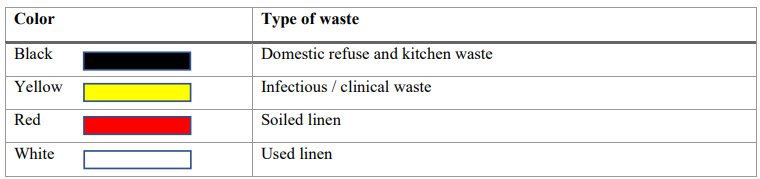
Storage – Segregated waste is stored temporarily in dedicated containers before being transported to treatment facilities.
Transportation – Licensed waste management companies transport the waste to designated treatment facilities under strict guidelines to prevent contamination.
Treatment and Disposal – In Mauritius, the main methods of treating medical waste include Incineration (High-temperature incineration is used for hazardous medical waste, ensuring complete destruction of pathogens and reducing the volume of waste) and Landfilling (Treated medical waste that is no longer hazardous is disposed of in controlled landfills). Autoclaving (Steam sterilization is applied to some infectious waste to eliminate pathogens before disposal) is being looked into.
Monitoring and Compliance – The Ministry of Health and the Ministry of Environment oversee medical waste management in Mauritius. Compliance with regulations and international best practices is essential to minimize environmental and health risks.
Disposal methods for different types of healthcare waste
| Type of biomedical waste | Example | Disposal method |
| Sharps | 1. Needle – a very fine, slender, hollow piece of metal used blood withdrawal and administering drugs 2. Syringe – device which a needle is attached to inject medication into or withdraw fluid from the body. 3. Lancet also called a “fingerstick” – principally used for blood glucose checking and monitoring 4. Auto injector, including epinephrine pens – syringe prefilled with fluid medication designed to be self-injected into the body. 5. Infusion set 6. Connection needle/set – needle that connects to a tube used to transfer fluids in and out of the body. This is generally used for patients on home hemodialysis. | Disposed of in sharps disposal container in the first instance. Further these sharp containers are discarded for incineration or treatment plant |
| Infectious Waste | Infectious waste is waste contaminated with blood and other bodily fluids (e.g., from discarded diagnostic samples), cultures and stocks of infectious agents from laboratory work (e.g., waste from autopsies and infected animals from laboratories), or waste from patients with infections (e.g., swabs, bandages and disposable medical devices). | Infectious waste is usually discarded in Mauritian health care settings in yellow bag. Bins for infectious waste must always be covered to reduce the risk of contamination. |
OTHERS 1. Radioactive Waste: Items used in lab research or therapy that are contaminated, including liquids, products, tubing and glassware. 2. Chemical Waste: Lab reagents, contaminated items, film developer, cleaners and disinfectant 3. Pharmaceutical Waste: Medication that is expired or contaminated 4. Containers under pressure: Gas cartridges and cylinders | This category of wastes is most prominent in specialized units e.g., oncology unit and New Cancer Center, laboratory settings and radiological departments | These types are wastes are sorted and have specific disposal methods. |
| General wastes | General wastes remain the most generated of waste in health care facilities. | General wastes are usually discarded in black plastic bags |
Source: Ministry of Health & Wellness
Challenges in Medical Waste Management
Despite having a structured system, Mauritius faces several challenges in handling medical waste:
- Limited Treatment Capacity – The country relies heavily on incineration, which has a limited capacity and may not be sufficient in the long term.
- Environmental Concerns – Incineration, if not properly managed, can release toxic pollutants, including dioxins and furans, into the atmosphere.
- Illegal Disposal Risks – Some healthcare facilities may not comply with waste disposal regulations, leading to illegal dumping and contamination.
- Need for Advanced Technologies – The adoption of newer, environmentally friendly technologies such as plasma gasification and microwave treatment is still limited.
Recommendations for Improvement
To enhance medical waste management in Mauritius, the following measures can be implemented:
- Strengthening Regulations – Enforce stricter policies on medical waste segregation, handling, and disposal to ensure full compliance.
- Improving Waste Treatment Facilities – Expand the capacity of existing incineration plants and explore alternative treatment technologies such as non-burn methods.
- Increasing Awareness and Training – Provide regular training programs for healthcare workers and waste management personnel on proper waste handling procedures.
- Enhancing Monitoring and Enforcement – Establish a robust monitoring system to track medical waste from its generation to final disposal.
- Promoting Waste Reduction and Recycling – Encourage hospitals and clinics to minimize waste generation through better inventory management and use of recyclable materials.
- Investing in Research and Development – Support studies on innovative and sustainable waste treatment solutions suitable for small island developing states like Mauritius.
- Disposal of pharmaceutical waste: Using blue bins
- Disposal Method: Autoclaving (Steam sterilization is applied to some infectious waste to eliminate pathogens before disposal)