Mauritius generated 550,000 tonnes of solid waste in 2024, with a heavy reliance on landfill disposal at Mare Chicose; 550,000 tons in 2024. Despite ongoing recycling initiatives and waste reduction measures, low recycling rates, limited waste treatment infrastructure, and increasing waste volumes pose serious challenges. To ensure long-term waste sustainability, Mauritius must expand recycling programs, invest in waste-to-energy solutions, and promote circular economy practices.
Mauritius, as a Small Island Developing State (SIDS), faces significant challenges in solid waste management due to its limited land resources, increasing waste generation, and reliance on a single landfill at Mare Chicose. The country generates an estimated 1,500 tonnes of municipal solid waste (MSW) daily, amounting to ~550,000 tonnes annually. The lack of waste treatment and recycling infrastructure has resulted in heavy dependence on landfill disposal, which is becoming unsustainable.
Waste Characterization
Waste characterization studies are essential in understanding the composition of waste streams in Mauritius. These studies are pivotal for several reasons:
They help develop effective waste management strategies that are specifically adapted to local needs.
They enable stakeholders to analyze the potential for recovering different waste materials.
They facilitate the identification of waste origins, which is crucial for tracing and managing waste flows.
They assist in designing equipment tailored for waste processing needs.
They provide a comprehensive assessment of waste properties—physical, chemical, and thermal.
They ensure compliance with Mauritian environmental regulations.
They contribute to extending the lifespan of landfills by diverting waste to suitable processing facilities instead of disposal.
Furthermore, these studies are instrumental in:
Quantifying the total waste produced,
Gathering precise data on the composition of waste, including its biodegradable and organic content.
Such detailed insights allow policymakers to choose the most effective technologies for waste management, operation, and valorization.
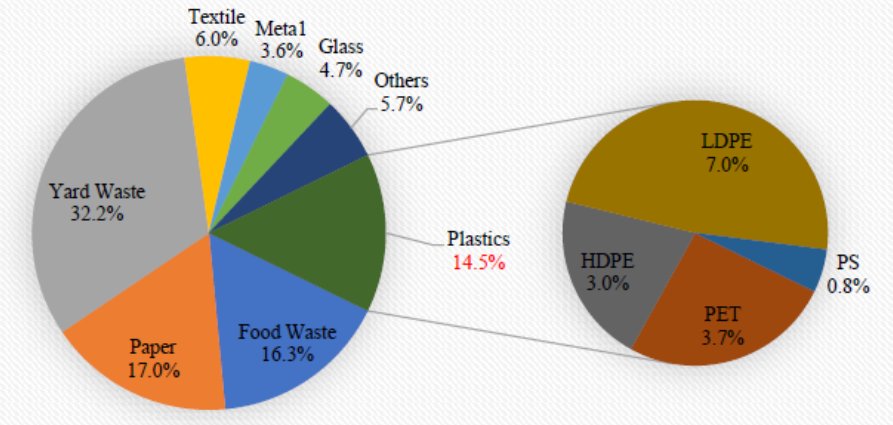
high density polyethylene (HDPE) (Plastic Crates, Containers): 3.0%
Polystyrene (PS) (Foam Packaging and consumer products): 0.8%
Glasses: 4.7%
Metals: 3.6%
Other Waste (Leather, Rubber, Ash, Ceramics, Electronics, etc.): 5.7%.
Organic wastes constitute the bulk of the waste, with one-third from yard wastes, one-sixth from food and another one-sixth from paper and cardboard wastes; (the paper waste generated constituted of primarily newspaper, packaging material as well as tissue paper). (Degradable organic waste represents 71.5% of the total municipal solid waste (MSW) Food Waste: 16.3%; Yard Waste: 32.2%; Paper Waste: 17.0% and Textile Waste: 6.0%). Plastics comes next with 14.5%.
The recyclable constituents in MSW include paper, plastic, metal, and glass.
The findings of this study revealed that Municipal Solid Waste (MSW) in Mauritius has a moisture content of ~33%, ash content of ~8%, and Net Calorific Value (NCV) of ~8.9 MJ/kg.
Solid Waste Management Practices
1. Waste Collection and Transfer Stations
Waste collection is managed by 12 Local Authorities, consisting of 5 Municipal Councils and 7 District Councils.
Mare Chicose Landfill
5 Transfer Stations Poudre D’Or Transfer Station (PDTS) Roche Bois Transfer Station (RBTS) La Laura Transfer Station (LLTS) La Brasserie Transfer Station (LBTS) La Chaumière Transfer Station (LCTS)
3 Civic Amenity Centres (CACs) Poudre D’Or Transfer Station (CAC PDTS) La Laura Transfer Station (CAC LLTS) La Chaumière Transfer Station (CAC LCTS)
1 Interim Storage Facility for Hazardous Wastes (ISFHW)
2. Landfilling at Mare Chicose
Mare Chicose is the only landfill in Mauritius, operational since 1997.
It receives over 550,000 tonnes of waste annually.
The landfill has a gas collection system, generating electricity (1.1 MW per engine across three engines).
3. Recycling and Composting
The recycling rate remains below 10%, despite 12 private recycling companies operating in Mauritius.
Materials recycled include:
Glass (via deposit-refund schemes)
Plastics (PET and HDPE)
Metals (scrap iron, aluminum, copper)
E-waste (batteries, circuit boards, appliances)
Paper (mainly for export)
The La Chaumiere composting facility, which had a capacity of 180,000 tonnes per year, ceased operations in 2017 due to technical and operational challenges.
Key Challenges in Waste Management
Limited Landfill Capacity
The Mare Chicose landfill is nearing saturation, requiring urgent waste diversion strategies.
Low Recycling Rates and Poor Waste Sorting
Lack of infrastructure for large-scale waste separation and processing.
Low public participation in recycling programs.
Plastic Pollution and Marine Debris
Plastics represent 14.5% of MSW, contributing to environmental contamination.
Single-use plastics remain an issue, despite the 2021 ban on plastic bags and polystyrene.
Construction and Demolition (C&D) Waste
C&D waste accounts for 20% of total waste generation but lacks a formal recycling system.
Crushed concrete and bricks could be reused in construction projects.
E-Waste Accumulation
The country lacks a formal e-waste collection and processing facility, despite rising volumes of discarded electronics.
Lack of Waste-to-Energy (WtE) Solutions
With high calorific waste content (GCV: 16.6 MJ/kg), waste-to-energy plants could reduce landfill pressure.
Proposed Solutions for Sustainable Waste Management
1. Enhancing Recycling and Circular Economy Initiatives
Invest in large-scale recycling facilities for plastics, paper, and metals.
Introduce Extended Producer Responsibility (EPR) programs for packaging and electronics.
Strengthen deposit-refund schemes for glass bottles and PET plastics.
2. Developing Waste-to-Energy Infrastructure
Utilize waste with high calorific value (plastics, textiles) for energy recovery.
Establish incineration or pyrolysis plants for non-recyclable waste.
3. Implementing Source Separation and Collection Programs
Introduce household-level waste sorting policies.
Develop composting initiatives for food and yard waste.
4. Strengthening Construction and Demolition (C&D) Waste Recycling
Promote reuse of building materials (bricks, concrete, steel).
Establish recycling facilities for gypsum board, tiles, and other inert materials.
5. Policy and Awareness Campaigns
Increase public education on waste sorting and reduction.
Provide incentives for businesses using recycled materials.
Some Trends & Observations - from the 2021 study
The high proportion of LDPE waste emanated may be explained by packaging and wrapping products that are utilized on a daily basis.
Plastic waste has experienced a growth of 13% from 2002 to14.5% in 2020.
Paper waste generation from 12% in 2002 to 17% in 2020. Apart from small and medium enterprises practicing paper recycling and upcycling, recycling practices at household level is also at a low level.
The low percentage of metal waste (3.6%) might be due to the fact that specific types of metals such as iron bars, aluminium frames are picked up by scrap dealers which are eventually sold to the manufacturing industries.
The low percentage of glass waste observed, 4.7%, might be due to the deposit-refund scheme of glass bottles and institutions such as the Mauritius Glass Gallery (MGG) which collate and upcycle glass materials to produce decorative objects.
Recycling is identified as a means to reduce the consumption of raw materials, conserve resources such as energy and water, and mitigate greenhouse gas emissions.
Recommendations
The study concluded with the following recommendations aimed at optimizing waste management strategies, emphasizing the need for tailored approaches based on the specific characteristics of different waste components:
Biological Treatment for Organic Fraction: Due to the substantial organic matter content, particularly in yard and food wastes, biological treatments such as anaerobic digestion and composting are recommended.
Caution with Waste-to-Energy (WtE) for Specific Wastes: Waste components like food and yard wastes, characterized by a low mean net calorific value and high moisture content, are not ideally suited for waste-to-energy (WtE) facilities.
Promote Appropriate Recycling: Explore and promote recycling opportunities to harness the solid waste stream as a raw material source for creating useful products. This approach also involves gathering information on recyclable materials to enhance recovery potentials.
Thermochemical Treatment for High-Energy Waste: Waste materials with high energy content can be directed towards thermochemical treatments, such as incineration.
Enhanced Segregation for Waste with High Moisture Content: Given the high moisture content of waste components, consider implementing segregation at the point of generation. This process separates waste materials with high energy content before utilizing them for waste-to-energy purposes.
Based on the waste characteristics analysis, the study suggests a combination of composting, anaerobic digestion, and recycling as suitable methods for managing municipal solid waste in Mauritius in the short and medium term.