
Mauritius is at a critical juncture in its waste management journey. While the country has a well-established collection and disposal system, long-term sustainability depends on shifting towards waste reduction, recycling, and energy recovery. Implementing modern waste management technologies and public engagement strategies will ensure environmental protection and resource efficiency for future generations.
Mauritius faces significant challenges in managing solid waste due to limited land availability, high population density, and reliance on imports. The country's solid waste management system follows a structured process, from waste generation to final disposal, including collection by Local Authorities or Private Contractors.
1. Waste Characterisation |
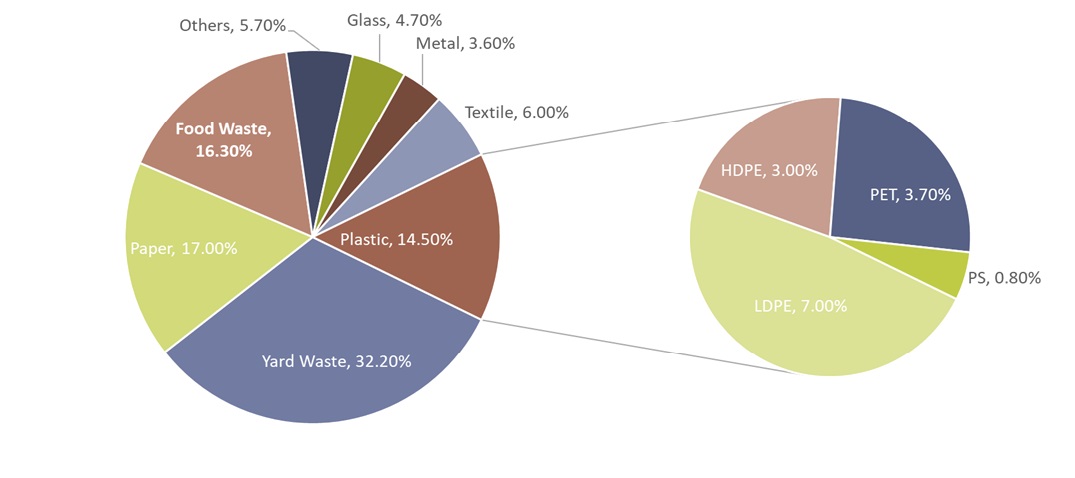
Source: National Solid Waste Characterisation Study In Mauritius Report (Reporting period: Nov 2019-Oct 2020) A 2021 National Solid Waste Characterisation Study (Google access) determined that the composition of Municipal Solid Waste (MSW) in Mauritius is as follows:
Organic wastes constitute the bulk of the waste, with one-third from yard wastes, one-sixth from food and another one-sixth from paper and cardboard wastes; (the paper waste generated constituted of primarily newspaper, packaging material as well as tissue paper). (Degradable organic waste represents 71.5% of the total municipal solid waste (MSW) Food Waste: 16.3%; Yard Waste: 32.2%; Paper Waste: 17.0% and Textile Waste: 6.0%). Plastics comes next with 14.5%. The recyclable constituents in MSW include paper, plastic, metal, and glass. The findings of this study revealed that Municipal Solid Waste (MSW) in Mauritius has a moisture content of ~33%, ash content of ~8%, and Net Calorific Value (NCV) of ~8.9 MJ/kg. |
2. Management of Municipal Solid Wastes in Mauritius |
Solid Wastes Management Infrastructures
For more information, please click here (READ MORE..)
Financial Implications for projects of Solid Waste Management Division 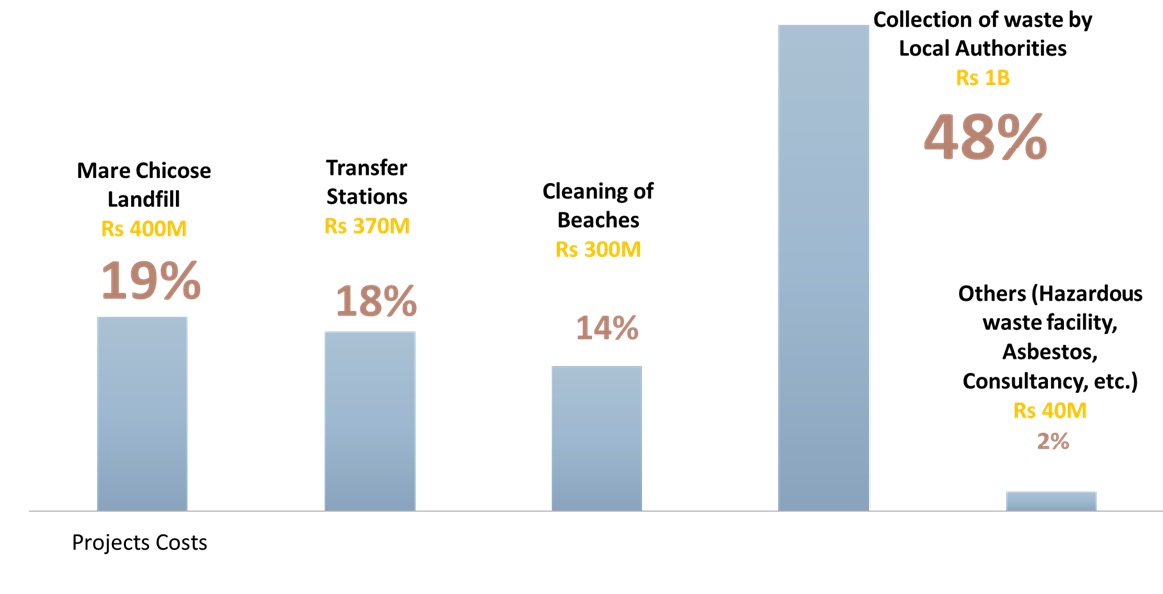 Source: Solid Waste Management Division, Ministry of Environment, Solid Waste Management and Climate Change
Please find the link to : Registration of Recyclers and exporters of wastes
|
3. Final Disposal: The Mare Chicose Landfill |
Mare Chicose is the only landfill in Mauritius, receiving over 1,500 tons of waste daily. It is an engineered landfill with:
For more information, please click here (READ MORE..) |
4. Future Strategies |
|