
Mauritius boasts a diverse array of water resources that are vital for its well-being and development. These resources are efficiently managed to ensure a consistent supply of fresh water for the island's population and its multifaceted needs.
Primary water resources in Mauritius | ||
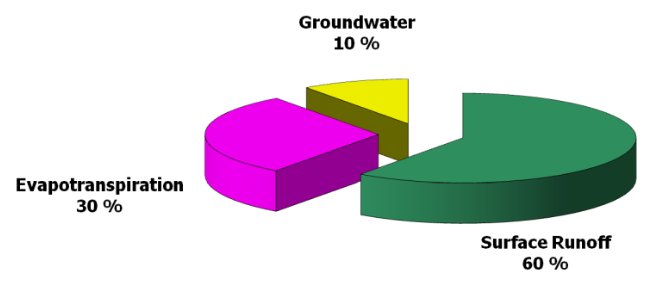
Rainwater is a crucial source of freshwater for Mauritius, serving as the primary contributor to its water supply. The Government and relevant agencies have established a network of reservoirs and catchment areas to capture and store rainfall efficiently. This system ensures a reliable and sustainable source of freshwater. Rainwater harvesting and storage systems are employed to capture and utilize this precipitation for various purposes, including irrigation and recharging groundwater aquifers. Mauritius, due to its unique topography, hydro-geological features, and tropical location, experiences high levels of rapid runoff, contributing only 10% to groundwater recharge, 30% evapotranspiration and 60% surface runoff of the water cycle respectively. Some of the surface runoff is channeled into impounding reservoirs, while the remainder either replenishes rivers for various uses or discharges directly into the ocean. The main source of domestic water supply is ground water (50%) which is abstracted through boreholes. The remaining 50% is derived from surface sources such as impounding reservoirs and river in takes.
| 
| |
Rainfall, Distributions, Trends, Implications and Considerations for Future | ||
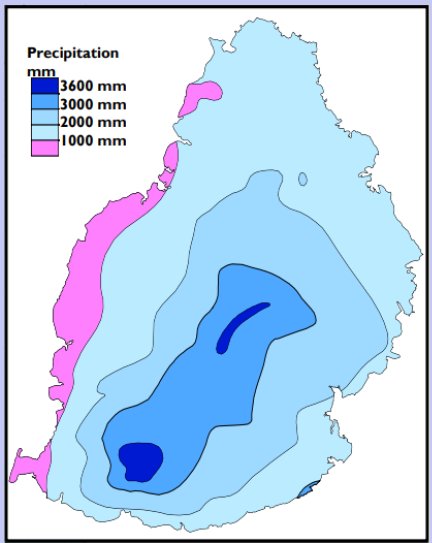
Rainfall distribution in Mauritius shows significant variation due to the island's topography, with amounts ranging from 1,400 mm on the eastern coast to 4,000 mm on the Central Plateau, and dropping to as low as 600 mm on the western coast. Annual Rainfall Variability: The annual rainfall shows significant variability from year to year, with notable peaks and troughs. The highest peaks seem to occur sporadically, with some of the most significant peaks around the mid-1940s, early 1960s, and around 1980. These peaks suggest years of particularly high rainfall. Linear Trend Line: The linear trend line is relatively flat, indicating that over the long term, the total annual rainfall in Mauritius has not shown significant changes or trends upwards or downwards. This suggests stability in the annual amount of rainfall over the century. 5-Year Moving Average: The 5-year moving average, which helps smooth out the data to provide a clearer view of the underlying trends, oscillates around the linear trend line. This line also indicates a lack of a strong upward or downward trend over the years, although there are periods of above-average and below-average rainfall relative to the long-term mean. Periods where the moving average rises above or dips below the linear trend suggest phases where the rainfall was consistently higher or lower than the average over a few years. For instance, the late 1970s into the early 1980s shows a period of higher than average rainfall. Long-Term Perspective: Over the 115 years represented in the graph, while individual years may have seen significant deviations in rainfall, the overall amount of rainfall when averaged over time has remained relatively constant. There doesn't appear to be a long-term increasing or decreasing trend in rainfall volumes.
| Average annual rainfall of about 1993 mm, totaling approximately 3700 Mm³ of water. see also Rainfall, Distribution & Trends
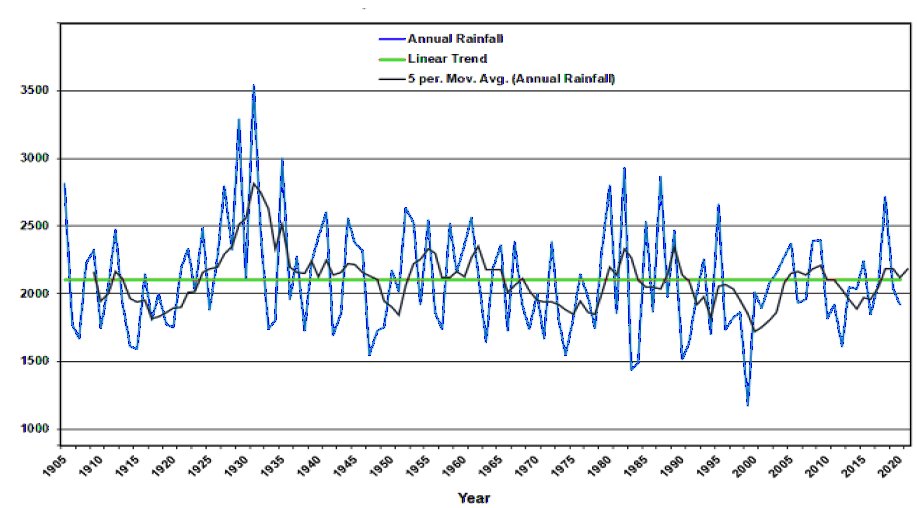 Precipitation (in mm) over Mauritius - from 1905 to 2020 (source: MMS) | |
Surface Water and Watersheds | ||
Surface water sources in Mauritius include rivers, streams, lakes, and reservoirs. Watersheds support the nation's water supply, agriculture, and environment by capturing rainfall and storing it in natural and artificial bodies. These sources are crucial for irrigation, industrial use, and drinking water. The construction of dams and reservoirs across Mauritius is vital, providing a stable water supply and supporting agriculture, particularly in cultivating sugarcane and other crops. Additionally, the island's lakes and ponds play multiple roles, from supporting biodiversity to recreational activities. |
see also | |
Ground water: Aquifers and Wells | ||
Groundwater exploitation in Mauritius dates back to the eighteenth century. In addition to surface water sources, Mauritius relies on underground aquifers as a supplementary source of freshwater for both domestic and agricultural purposes. These aquifers store water beneath the earth's surface, and wells and boreholes are used to extract this groundwater. While groundwater is not the primary source of water for Mauritius, it serves as an important backup during periods of water scarcity or increased demand. The Central Water Authority (CWA) manages and monitors groundwater resources to ensure sustainability and prevent over-extraction. |
see also | |
Sustainable Water Management
The following strategies collectively demonstrate Mauritius' commitment to sustainable water management, addressing the challenges of limited water resources, pollution control, agricultural demands, and ensuring clean water access for all its citizens:
Water Conservation
Mauritius employs various water conservation techniques to manage its limited freshwater resources effectively. One primary method is rainwater harvesting, which is encouraged among residential and commercial properties to reduce dependency on municipal water supplies. For example, the government offers incentives for installing rainwater collection systems. Another significant conservation effort is public education campaigns aimed at reducing water wastage. These initiatives promote water-saving practices such as fixing leaks promptly, using water-efficient appliances, and implementing water-wise gardening techniques.
Water Pollution Control
Controlling water pollution is crucial for maintaining the health of Mauritius' water bodies. The government implements strict regulations to manage industrial discharge, which includes setting limits on pollutants released into waterways. For instance, sugar and textile industries, which are prominent on the island, are required to treat wastewater before disposal to prevent contaminants from entering rivers and groundwater. Additionally, Mauritius has developed programs for the safe disposal of agricultural chemicals to prevent runoff into rivers and streams. Efforts such as the construction of containment facilities and the promotion of integrated pest management practices help minimize the impact of agricultural pollutants.
Irrigation and Farming Practices
Efficient irrigation and sustainable farming practices are vital for maximizing water use in agriculture while minimizing environmental impact. In the sugarcane sector, pivot irrigation is quite common. Mauritius has introduced drip irrigation systems, which deliver water directly to the plant roots, significantly reducing evaporation and runoff compared to traditional methods like flood irrigation. The government also supports the transition to organic farming practices, which typically require less water and reduce the need for chemical fertilizers and pesticides. These practices not only conserve water but also improve soil health, leading to better water retention in agricultural fields.
Water Treatment and Distribution
Mauritius has invested in advanced water treatment facilities to ensure a safe and reliable supply of potable water to its residents. For example, the La Nicolière Treatment Plant utilizes modern filtration and disinfection technologies to treat water from the La Nicolière Reservoir, a major source of drinking water for the northern parts of the island. In terms of distribution, the Central Water Authority manages a complex network of pipes and pumping stations designed to minimize losses and ensure efficient water delivery to urban and rural areas alike. The implementation of smart water meters across the island helps in detecting leaks and managing water use more effectively.