
Climate Profiles and Projections (Mauritius)


Climate Zone:  Mauritius:   Af; Am

Mauritius enjoys a mild tropical maritime climate throughout the year. The country has two seasons: a warm humid summer extending from November to April and a relatively cool dry winter from June to September. The month of October and May are commonly known as the transition months.
The warmest months are January and February with average day maximum temperature reaching 30.0 ºC and the coolest months are July and August when average night minimum temperatures drop down to 17.3 ºC.
Long term mean annual rainfall (1991-2020) over the Island is 2019 mm. 

The wettest months are February and March. 

The driest month is October.
Mean summer rainfall (1991-2020) is 1352 mm, which is 67% of the annual amount over the Island. 

Mean winter rainfall (1991-2020) is 668 mm.


Current and Historical Climate Data

Typical Temperature and Precipitation  

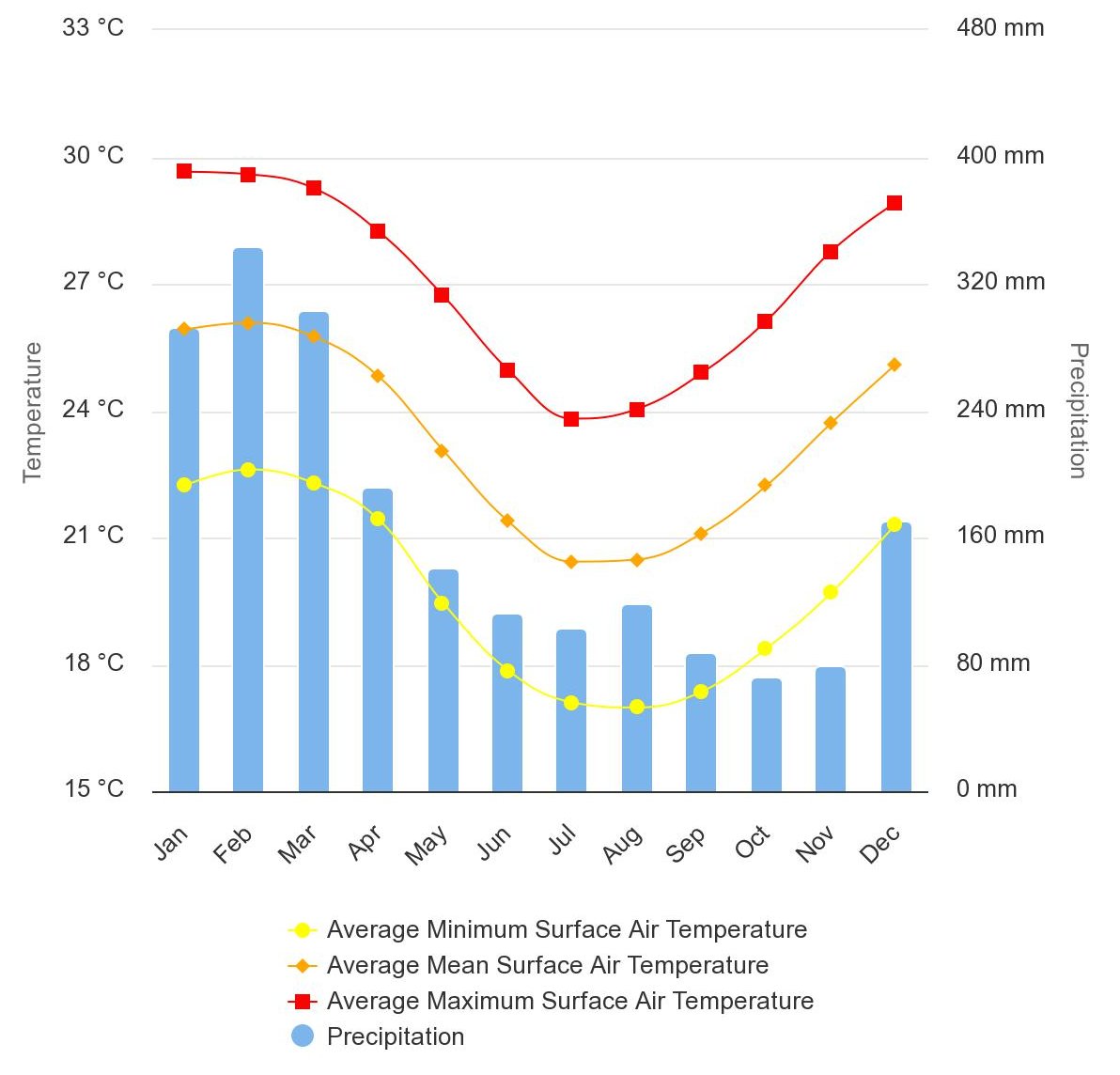
The chart below illustrates the climatology of Mauritius, showing variations in temperature and precipitation throughout the year.  The climate profile depicted in the chart is typical of a tropical environment with a clear wet season and a pronounced dry season. The temperature remains relatively stable and warm throughout the year, supporting a variety of ecological and agricultural activities. The high precipitation in the early months can be critical for water resources, while the dry season may require strategic water management and conservation efforts. This pattern is essential for planning in agriculture, tourism, and infrastructure development in Mauritius.

  • Temperature  
    • The average maximum surface air temperature (red squares) peaks in January and February at around 29.4 °C, decreasing gradually until July, where it reaches its lowest at around 24 °C - conducive to outdoor activities and tourism.  After July, the temperature begins to rise again, closing the year near 29 °C.

    • The average mean surface air temperature (orange circles) follows a similar pattern, peaking around 26 °C in the early months and dipping to about 22 °C in the cooler months of June through August.

    • The average minimum surface air temperature (yellow circles) shows less variation, ranging from around 20.5 °C in the cooler months to around  24 °C in the warmer months, indicating relatively mild night-time and comfortable conditions throughout the year.


Rainfall 
  • Precipitation (blue bars) is highest from January through April, peaking in March at nearly 350 mm. This suggests a significant wet season early in the year.

  • There is a marked dry season from May to October, with the lowest rainfall in October at just under 80 mm, after which precipitation increases again in November and December.

  • Historical Averages: Between 1971 and 2000, Mauritius recorded an average annual rainfall of 2010 mm. This figure slightly decreased to 1999 mm annually from 1981 to 2010. Data from 1991 to 2020 shows a slight increase in average annual rainfall to 2019 mm, indicating possible variations due to climatic changes over the decades.


Temperature Distribution

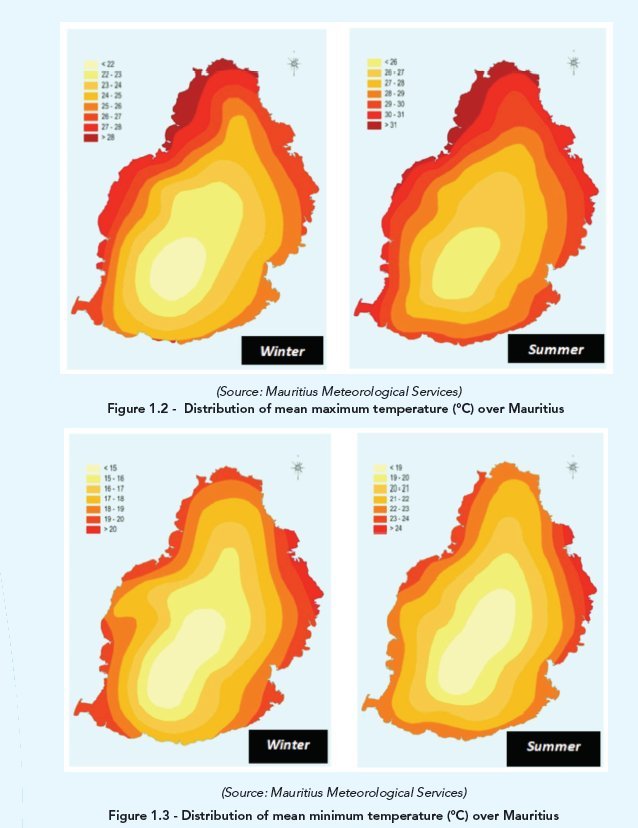
The figures illustrate the distribution of mean maximum and mean minimum temperatures across Mauritius during winter and summer seasons.

Mean Maximum Temperature Distribution:

During the winter, the distribution shows cooler temperatures towards the central parts of the island, where temperatures are below 22°C. The coastal areas experience warmer temperatures, generally between 26°C to 28°C. This indicates a temperature gradient influenced by elevation and proximity to the sea.
In the summer, the entire island experiences higher temperatures. The central parts remain cooler than the coastal areas but still warmer than in winter, showing temperatures around 26°C to 28°C. Coastal regions during summer can reach up to 31°C, highlighting the significant warming effect during the hotter months.


Mean Minimum Temperature Distribution:

The mean minimum temperatures in winter indicate a cooler central region, with temperatures ranging from 15°C to 18°C, and warmer coastal areas, with temperatures generally between 18°C to 20°C. The coldest areas are centrally located, likely influenced by higher altitudes.
The summer map shows an overall increase in minimum temperatures across the island, with central parts ranging from 18°C to 21°C and coastal regions slightly warmer at around 22°C to 24°C.
 

These temperature distributions emphasize the thermal variation between the central and coastal regions of Mauritius, influenced by altitude and sea proximity. The central highlands are consistently cooler, a common feature in island climates with varied topography. This data is crucial for understanding climatic variations within the island, which can impact agricultural planning, tourism, and habitat distribution. The clear seasonal differences also underline the need for adaptive strategies in various sectors to manage the summer heat and cooler winter conditions, particularly in more temperature-sensitive activities.


Rainfall Distribution

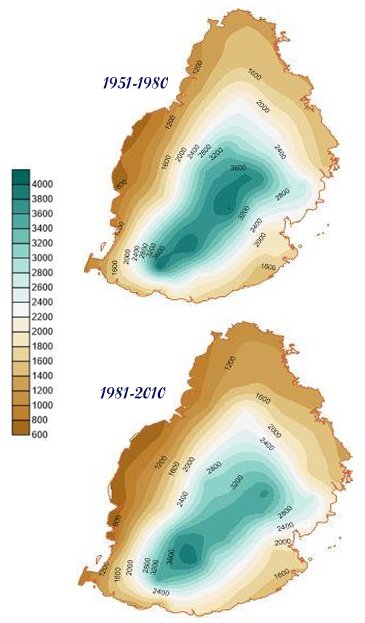
The figures display the long-term annual rainfall distribution over Mauritius for two distinct periods: 1951-1980 and 1981-2010. These maps offer a clear visualization of how rainfall patterns have evolved over time across different regions of the island.

  • 1951-1980: During this period, the central regions of Mauritius experienced the highest annual rainfall, exceeding 3600 mm in some areas, reflecting a typical concentration of rainfall in higher altitudes. The coastal regions received considerably less rainfall, with amounts generally ranging from 800 to 2400 mm annually.

  • 1981-2010: In the more recent period, the distribution pattern remains similar, with the central areas receiving the most rainfall. However, there's a noticeable shift in the maximum amounts, with some central areas receiving over 4000 mm annually, indicating an increase in rainfall in these regions. Coastal areas still receive less rainfall but show a slight increase compared to the earlier period.

  •  

  • Increase in Rainfall: There is a general increase in rainfall amounts, particularly in the central regions. This could be indicative of changes in climatic conditions, possibly influenced by global climate change.

  • Rainfall Gradient: Both periods exhibit a clear rainfall gradient from the coast to the central parts of the island, which is consistent with the topographical influence on rainfall distribution. Higher elevations in the central regions capture more moisture from the air, leading to higher precipitation.

Implications: These changes in rainfall patterns could have significant implications for water resource management, agriculture, and flood risk management in Mauritius. Increased rainfall in the central regions might enhance water availability but also increase the risk of floods and landslides. Conversely, the slight increase in coastal rainfall could benefit coastal agriculture but might also necessitate adjustments in urban drainage and flood prevention strategies.

Data from these maps is crucial for planning and adapting to changing rainfall patterns, ensuring sustainable development and disaster risk management in Mauritius.


Changing Temperature Patterns

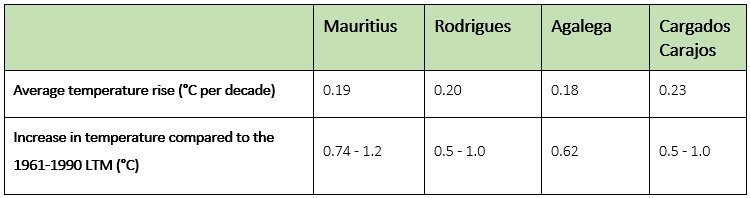
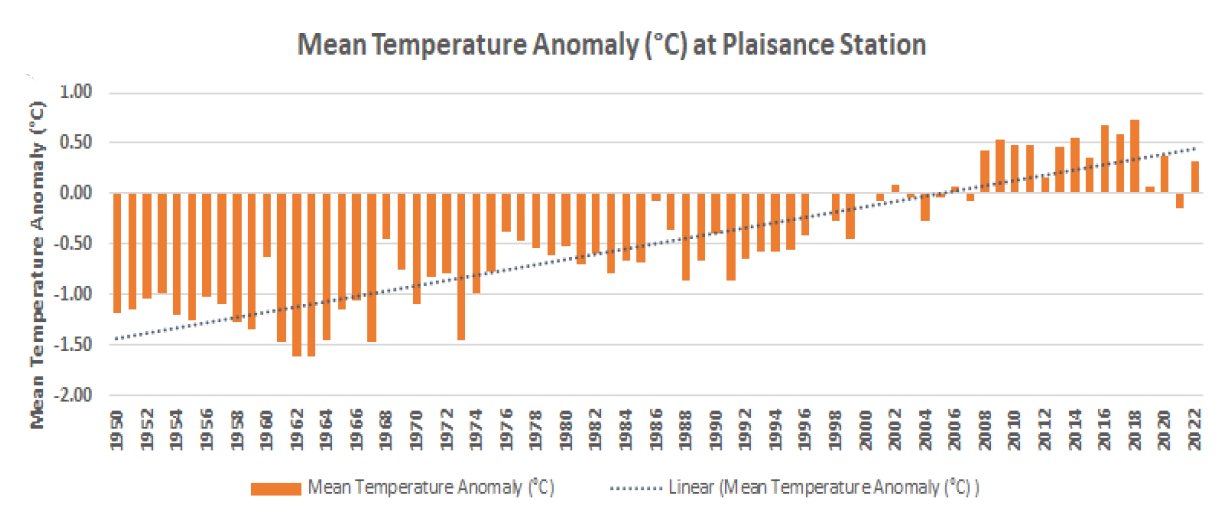
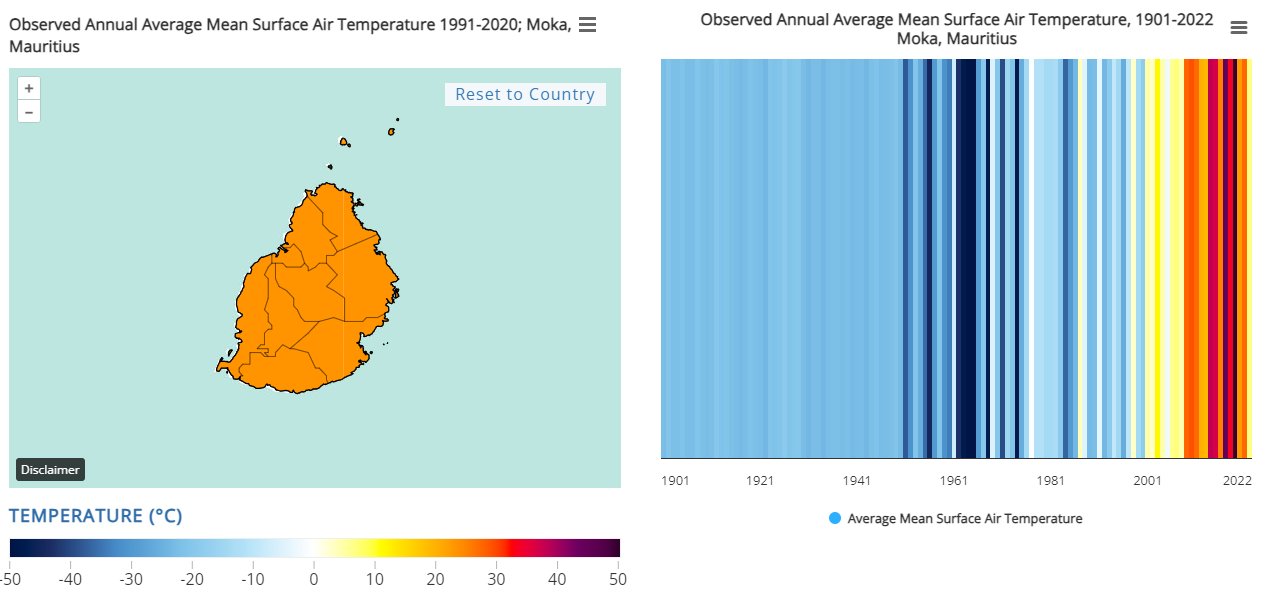
Climate records over the period 1951-2014 show a significant warming trend of about 1.2 °C in Mauritius. 

Analysis of temperature records indicate that the observed rate of temperature change is on average 0.020°C/yr for Mauritius for the period 1951-2014. 

Over the period 1961 to 2014, the mean maximum temperature has increased by 0.023 °C  and the mean minimum temperature by 0.016 °C (TNC, 2016) .  

For projection - see below.


source: MMS

source: BTR1, 2024

Changing Rainfall Patterns

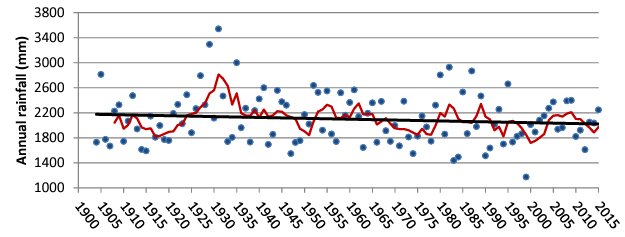
The graph displays the trend of annual rainfall in mm over a century-plus timeframe, from around 1900 to 2015.  

  1. The individual annual rainfall measurements show considerable variability from year to year. Such variability can be crucial for water resource management, agriculture, and flood risk planning.

  2. The moving average line fluctuates around the 2200 mm mark, suggesting that despite annual variations, the central tendency over the years does not stray far from this value. While the moving average line shows periods of above-average and below-average rainfall, the overall pattern doesn't indicate any drastic long-term changes, although a slight long-term decrease is visible. This might be influenced by broader climatic patterns or local changes in land use or atmospheric conditions.

  3. The trend line shows a very slight downward trend in annual rainfall over the entire period, suggesting a long-term decrease in rainfall, although the slope is quite gentle. Analysis of rainfall over the period 1951 -2014 reveals a decreasing trend in rainfall amount of about 8% for Mauritius. The downward trend , if continued, could have long-term implications for water availability, agricultural productivity, and the natural ecosystem. However, the mildness of the slope suggests that any changes are gradual.

  •  

The graph illustrates the complexity of rainfall patterns and the importance of long-term data in understanding climatic trends. The slight downward trend in annual rainfall, as shown by the linear trend line, while not steep, warrants monitoring given the potential implications for water resources and environmental management in the region. This data is invaluable for planning and adaptation strategies in response to potential climatic shifts.

For projection - see below.


The blue dots represent individual annual rainfall measurements.  

The red line is the moving average, smoothing out the yearly fluctuations to provide a clearer view of the underlying trend.  

The black line represents a linear trend across the entire data set.  


Typical Rainfall Phenomena and Events in Mauritius

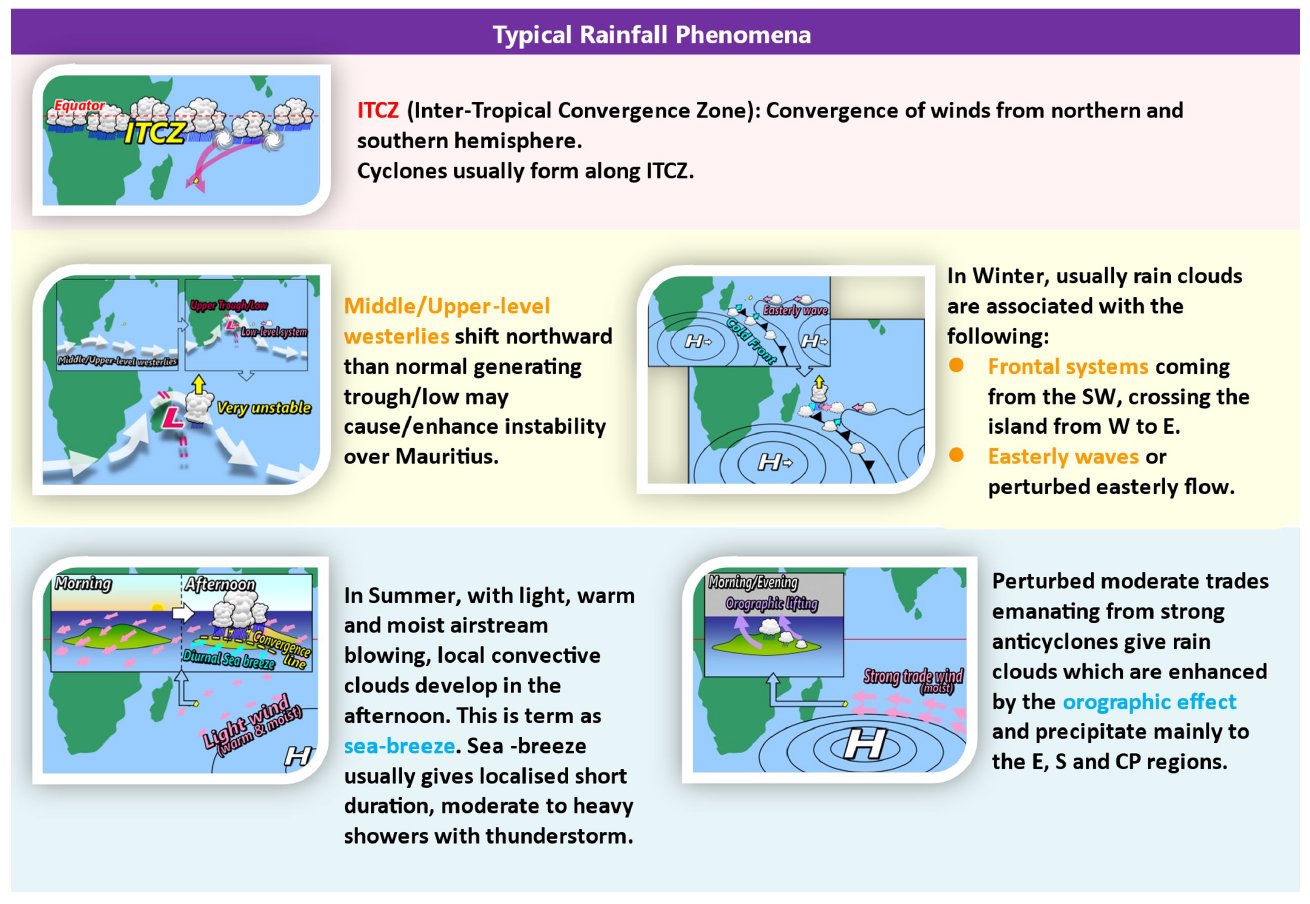
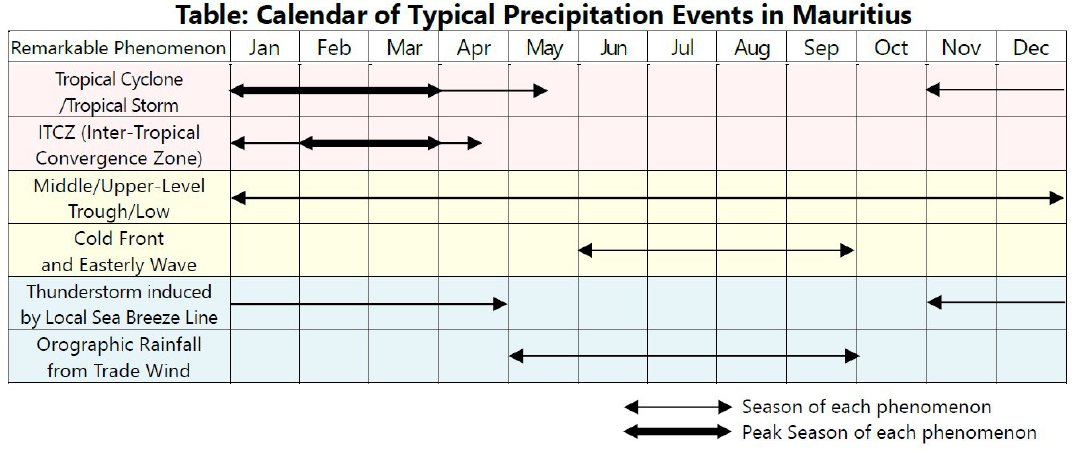
This table visually represents the occurrence and intensity of various meteorological phenomena throughout the year in Mauritius, including:

  • Tropical Cyclone/Tropical Storm: This is shown occurring from January through April with a peak in February and March.
    ITCZ (Inter-Tropical Convergence Zone): This spans from January to May, indicating a broader range of influence.
    Middle/Upper-Level Trough/Low: Noted in the months of January, May, and from July to December, with more occurrences in September and October.
    Cold Front and Easterly Wave: These are marked from May to August.
    Thunderstorm induced by Local Sea Breeze Line: Highlighted in November and December.
    Orographic Rainfall from Trade Wind: This is observed from June through October, peaking in August and September.
    This visualization on understanding of the precipitation patterns and significant weather phenomena affecting Mauritius throughout different times of the year can be very useful for planning agricultural activities, disaster preparedness, and general awareness of weather conditions.


Daylight & Sunshine

  1. Sunrise Sunset Mauritius
  2. Sunrise Sunset Rodrigues


Sun Path and Sunset Duration

The Sun's path and a location's distance from the equator not only affect sunrise and sunset times but also change the duration of sunset. Near the equator, sunsets typically last about 20 minutes. However, Mauritius, situated at 20 degrees S latitude, sunset durations are longer, averaging 26 minutes—25 minutes in June and 26 minutes in December.

Astronomical Day Length and Sunshine Duration

The length of the day from sunrise to sunset, known as the astronomical day length, is constant and independent of visible Sun conditions. Factors like cloud cover and physical obstructions can affect how much sunlight actually reaches the ground. In Port Louis, the sunshine duration varies; for instance, in June, there is about 7:06 hours of sunlight during a 10:57-hour day, indicating about 3:51 hours of obstruction. In December, sunlight lasts for 5:47 hours of a 13:23-hour day.

Sun Position Throughout the Year

Mauritius, at 20 degrees south latitude, sees the Sun cross directly overhead twice annually—on January 21st and November 22nd. During this period, the Sun moves from being north of the island to south. Due to its tropical location, the Sun is high in the sky at midday, providing intense sunlight. Notably, during the winter solstice on June 21st, the Sun is at its lowest midday position, reaching only 46.4 degrees above the northern horizon.


Average length of day https://www.worlddata.info/ 

Actual hours of sunshine  https://www.worlddata.info/ 

Humidity

Mauritius, with its tropical climate, typically experiences high humidity levels throughout the year, which is characteristic of oceanic islands in such climatic zones.  

General Humidity Conditions

  • Consistency: Humidity levels in Mauritius are consistently high, often exceeding 80% throughout much of the year. This high humidity is a direct result of the island's surrounding ocean and tropical climate, which contributes to substantial moisture in the air.

  • Seasonal Variations: There can be some seasonal fluctuations in humidity. During the summer months, from November to April, humidity levels are generally higher due to increased temperatures and more frequent rainfall. The winter months, from May to October, while still humid, might experience slightly lower humidity levels due to cooler temperatures and less frequent rain.

  •  

Regional Variations

  • Coastal vs. Inland: Coastal areas tend to have slightly lower humidity levels compared to the central highlands. The sea breezes in coastal regions can help moderate the humidity, making the climate somewhat more comfortable than in enclosed or elevated inland areas where humidity can feel more oppressive.

  •  

Impact of Humidity

  • Comfort and Health: High humidity levels can affect comfort and health, leading to increased perspiration and a heightened sensation of heat. It can also exacerbate some respiratory conditions and influence the prevalence of mold and mildew in homes.

  • Agriculture: For agriculture, humidity can be a double-edged sword. While it is beneficial for certain crops by reducing the need for irrigation, excessive humidity can also encourage the growth of pests and diseases.

  • Tourism: Tourists to Mauritius might find the high humidity challenging, especially during the hotter months. However, the lush landscape that benefits from this humidity is also a significant draw for visitors.

  •  

Adaptation Strategies

  • Architecture and Living Conditions: Buildings in Mauritius are often designed with high humidity in mind, featuring ventilation strategies that help manage indoor humidity levels and heat.

  • Agricultural Practices: Farmers utilize practices suited to the humid climate, such as choosing crop varieties that are tolerant to the conditions and employing disease and pest management strategies tailored to such an environment.


Humidity is a constant feature of the Mauritian climate, influencing various aspects of daily life and economic activities on the island. Effective management and adaptation strategies are key to living comfortably and sustainably in such a humid environment.

Relative humidity in %

https://www.worlddata.info/ 

https://www.worlddata.info/ 


Microclimates

Mauritius, despite its small size, exhibits a variety of microclimates due to its diverse topography, which includes mountains, plateaus, and coastal plains. These microclimates significantly influence the island's weather patterns, affecting everything from agriculture to tourism.  Overall, the microclimates of Mauritius add to its charm and complexity, offering a unique set of conditions that influence daily life, economic activities, and environmental policies on the island.

Factors Influencing Microclimates

  • Topography: The central plateau, surrounded by mountain ranges, tends to be cooler and wetter compared to the coastal areas. Elevations influence temperature drops and increased rainfall, creating distinct climate zones within a relatively compact area.

  • Proximity to the Sea: Coastal areas experience more moderate temperatures due to sea breezes. The eastern coast, exposed to prevailing trade winds, tends to be cooler and windier than the western coast, which is more sheltered and warmer.

  • Vegetation: Areas with dense vegetation, like the Black River Gorges National Park, can have cooler temperatures and higher humidity. Vegetation affects soil moisture retention and air quality, further diversifying the microclimates.

  • Urbanization: Urban areas such as Port Louis experience the urban heat island effect, where concentrations of buildings and infrastructure lead to higher temperatures than surrounding rural areas.


Implications of Microclimates

  • Agriculture: Understanding microclimates is crucial for agriculture, as different crops require specific conditions. For instance, tea is predominantly grown in the cooler, wetter central highlands, while sugarcane is more widespread, including in warmer, drier areas.

  • Tourism: Tourists can experience different climates depending on where they visit on the island. The variety of microclimates makes Mauritius a year-round destination but also requires tourists to plan according to the specific weather patterns of their chosen locations.

  • Conservation and Sustainability: Conservation efforts need to account for the diverse microclimates to protect various ecosystems effectively. Sustainable practices must be tailored to local conditions, particularly in response to climate change, which could exacerbate or alter existing microclimates.


The climatology for the western, northern, eastern, southern, and central regions of the island is detailed in the PDF documents provided below. The areas of Medine, Pamplemousses, Fuel, Plaisance, and Vacoas represent these five respective regions.


North


West
Centre
East 


South


Key Microclimates in Mauritius

  • Central Plateau: Characterized by cooler temperatures and higher rainfall, especially during the summer months. This area can be quite misty compared to other parts of the island.

  • East Coast: The east coast is generally windier and slightly cooler, influenced by the southeast trade winds. This results in a climate that can be less comfortable for beach-goers but ideal for wind sports like kitesurfing.

  • North Coasts: These areas are warmer and drier, making them popular for tourism.

  • West Coasts: These areas are warmer and drier, making them popular for tourism. The leeward side of the island is shielded from direct trade winds, resulting in more sunny days and higher temperatures.

  • South Coast: The south coast is known for its rugged terrain and slightly more temperate climate. It receives more rainfall and has stronger winds, influencing both the natural landscape and the type of tourism activities that are popular here.

Climate Extremes, Impacts & Projections

  •  

  •  


Future Projections

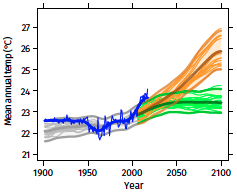
Projection - Mean annual temperature, 1900–2100

  • Climate projections for Mauritius between 2051 and 2070 suggest a significant warming trend under two different climate scenarios. 


  • Compared to the baseline period from 1996 to 2005, temperatures are expected to rise by 0.9°C to 1.4°C under a moderate mitigation scenario and by 1.3°C to 1.6°C under a higher emissions scenario. Additionally, under the Representative Concentration Pathway (RCP) scenarios, RCP 4.5, which assumes moderate mitigation measures, and RCP 8.5, which assumes continued high emissions without additional mitigation ('business as usual'), temperatures could increase by as much as 2°C. These projections underscore the urgent need for climate action to manage potential impacts on the island's environment and community.

  •  

  • High Emissions Scenario: With high emissions, the average annual temperature is projected to increase by approximately 2.8°C by the end of the century (2071–2100 compared to 1981–2010).

  • Rapid Emissions Reduction: If emissions are quickly reduced, the projected temperature rise is limited to around 0.8°C.


Temperature Projections for Mauritius for RCP 4.5 and RCP 8.5   (source: TNC, 2016)

source; ClimaHealth, WMO

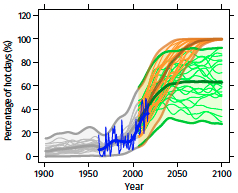
Projection - Percentage of hot days (‘heat stress’), 1900–2100


Historical Context: Historically, about 15% of days were classified as 'hot' on average between 1981 and 2010, compared to 10% between 1961 and 1990.
High Emissions Scenario: Under a high emissions scenario, nearly 100% of days are projected to be 'hot' by the end of the century.
Rapid Emissions Reduction: With rapid emissions reduction, approximately 65% of days are expected to be 'hot'.
Model Accuracy: It's important to note that models tend to overestimate the observed increase in hot days by about 4% for the period 1981–2010.
Hot Nights: Similar trends are observed with increases in hot nights, although specific data is not shown here.


source; ClimaHealth, WMO

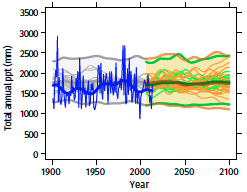
Projection - Total annual precipitation, 1900–2100

  • Projections for RCP 4.5 and RCP 8.5 scenarios, does not show significant variation with respect to the present rainfall pattern. Nevertheless, the precipitation seasonal cycle shows an increase in monthly precipitation during the period from May to October as depicted in Figure..

  •  

  • High Emissions Scenario: With high emissions, the average annual temperature is projected to increase by approximately 2.8°C by the end of the century (2071–2100 compared to 1981–2010).

  • Rapid Emissions Reduction: If emissions are quickly reduced, the projected temperature rise is limited to around 0.8°C.


Precipitation Projection for Mauritius for RCP 4.5 and RCP 8.5 (source: TNC, 2016)

source; ClimaHealth, WMO

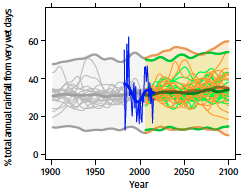
  • Projection - Contribution to total annual rainfall from very wet days (‘extreme rainfall’ and ‘flood risk’), 1900–2100

  • High Emissions Scenario: Currently, very wet days account for approximately 32% of total annual rainfall (1981–2010). By the end of the century, this could increase slightly to around 35%, with an uncertainty range from 12% to 57% under a high emissions scenario.

  • Rapid Emissions Reduction: With a rapid decrease in emissions, the increase in rainfall from very wet days is expected to be less significant.

  • Overall Rainfall Trends: Despite these variations in very wet days, the total annual rainfall is projected to show little change, as illustrated in Figure 2.


source; ClimaHealth, WMO

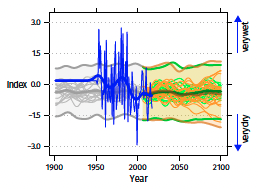
Projection - Standardized Precipitation Index (‘drought’), 1900–2100

The Standardized Precipitation Index (SPI) is a widely utilized index for measuring drought, assessing rainfall excesses or deficits over periods ranging from 1 to 36 months, with this discussion focusing on a 12-month period (SPI12). The index tracks how the frequency and/or intensity of extremely dry and wet conditions change relative to local averages.

Projections suggest that SPI12 values will remain fairly stable, with an average around -0.4, indicating minimal changes in the frequency and/or intensity of both wet episodes and drought events. Despite this overall stability, year-to-year variability is expected to remain high, with both wet and dry periods of various intensities continuing into the future.


source; ClimaHealth, WMO