
Greenhouse Gases (GHGs) | FACTS & FIGURES | |
A greenhouse gas (GHG) is any gaseous compound in the atmosphere that is capable of absorbing infrared radiation, thereby trapping and holding heat in the Earth's atmosphere. This process is known as the greenhouse effect. By increasing the heat in the atmosphere, greenhouse gases are responsible for the greenhouse effect, which ultimately leads to global warming and climate change. GHGs are gases occurring naturally but are also resulting from human-induced activities (anthropogenic emissions from production and consumption). Carbon dioxide (CO2) makes up the vast majority of greenhouse gas emissions, but smaller amounts of methane (CH4) and nitrous oxide (N2O), and other GHGs such as refrigerant gases (HCFCs and HFCs) are also emitted. These gases have varying levels of impact on the Earth's climate based on their ability to absorb energy and their lifespan in the atmosphere. | Source: United Nations Environment Programe (UNEP), Emissions Gap Report 2023)
Source: Biennial Transparency Report (BTR), 2024
GHG Share-outs: 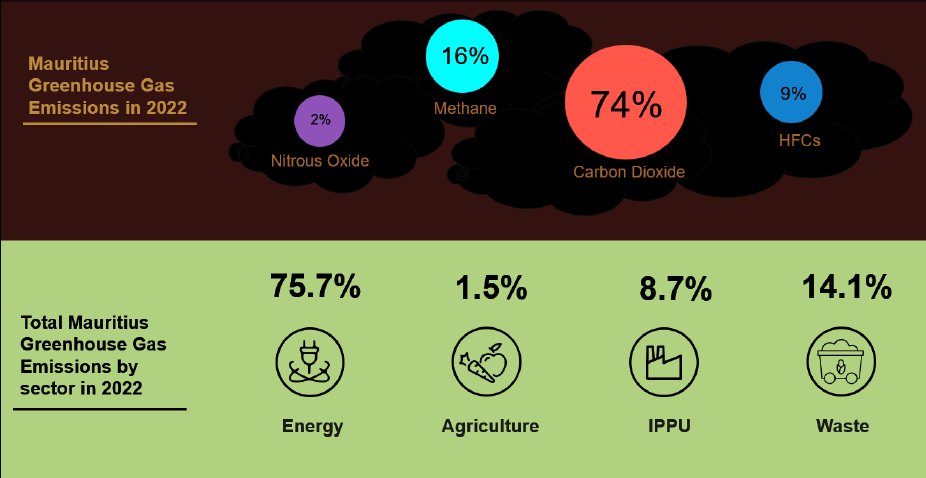 | |
Initiatives and Commitments of Mauritius | Chronology of Engagements | |
Mauritius has engaged in several initiatives and commitments to address greenhouse gas (GHG) emissions and their impacts on climate change. Some key engagements include: Nationally Determined Contributions (NDCs): Mauritius has committed under the Paris Agreement to reduce its GHG emissions. The country's NDCs include specific targets for reducing emissions by a certain percentage relative to business-as-usual scenarios by 2030. These engagements demonstrate Mauritius's active approach to managing GHG emissions and mitigating climate change impacts, aligning with global efforts and contributing to sustainable development goals. Monitoring of GHG EmissionsMauritius monitors greenhouse gas (GHG) emissions through a structured national system aligned with international guidelines provided by the Intergovernmental Panel on Climate Change (IPCC). This system involves the following key components: National GHG Inventory System: Mauritius has established a comprehensive inventory system that regularly collects data on GHG emissions from various sectors including energy, industry, agriculture, waste, and land use. This system follows the methodologies recommended by the IPCC, which ensure consistency, accuracy, and comparability with international standards. | 1992 - Earth Summit in Rio:Mauritius participated in the United Nations Conference on Environment and Development (UNCED), also known as the Earth Summit, leading to the signing of the United Nations Framework Convention on Climate Change (UNFCCC). 1997 - Kyoto Protocol:Mauritius signed the Kyoto Protocol, committing to GHG emissions reduction targets and participating in mechanisms such as the Clean Development Mechanism (CDM). Obligations/ Outcomes: To achieve the objective of the UNFCCC by setting legally binding quantified emission reduction targets for participating developed countries. Kyoto Protocol entered into force on 16 February 2005. Currently, there are 192 Parties to the Kyoto Protocol. Its first commitment period started in 2008 and ended in 2012. The Doha Amendment was adopted in Doha, Qatar, on 08 December 2012. It relates to the second commitment period, beginning 1 January 2013 and ending in 31 December 2020. Implementation/ Submission: Closure for the CDM projects will be done in 2026 through the submission of reports and issuance of certificate of closure.
| |
Reporting Obligations | Submissions to UNFCCC Secretariat | |
As per its obligations under the United Nations Framework Convention on Climate Change (UNFCCC), the Republic of Mauritius (RoM) is required to submit a comprehensive national inventory of GHG emissions (including removals and sinks) more or less regularly to the UNFCCC Secretariat. In April 1999, the Republic of Mauritius (RoM) submitted its inaugural Greenhouse Gas (GHG) inventory as part of its Initial National Communication. Subsequently, during the preparations for the Second and Third National Communications, Mauritius developed an enhanced standalone National GHG Inventory Report. In December 2021, this report was submitted alongside the first Biennial Update Report (BUR) to the UNFCCC. Additionally, the Republic of Mauritius submitted its national GHG emissions inventory covering the period from 2000 to 2022, along with its First Biennial Transparency Report (BTR) to the UNFCCC Secretariat on December 31, 2024. Accordingly, the National Inventory was updated for the period 2000 – 2016 in the light specifically developed for the years 2017 – 2022 as a national inventory document (NID) (NID, 2024). To comply with UNFCCC reporting standards, Mauritius's GHG national inventory categorizes emissions into four primary sectors: Energy, Industrial Processes and Product Use (IPPU), Agriculture, Forestry and Other Land Use (AFOLU), and Waste (both solid and liquid). Each sector is broken down into further detailed categories. The methodology adopted for compiling the national inventory adheres to the 2006 Guidelines for National Greenhouse Gas Inventories by the Intergovernmental Panel on Climate Change (IPCC), which also includes adherence to the Good Practice Guidance. The NID is prescribed in the Modalities, Procedures and Guidelines for the transparency framework for action and support referred to in Article 13 of the Paris Agreement (Annex to Decision 18/CMA.1, hereinafter referred to as the “MPGs”) as a stand-alone report. | 1999 - Initial National Communication (NC) and National Inventory Report (NIR): Mauritius submitted its Initial National Communication and the accompanying National Inventory Report to the UNFCCC, outlining early efforts and baseline assessments of GHG emissions.
2016 - Third National Communication (TNC) and National Inventory Report (NIR): Mauritius submitted its Third National Communication and the accompanying National Inventory Report, enhancing the depth of climate action reporting and providing further insights into adaptation and mitigation strategies.
2025 - The Third Nationally Determined Contribution (NDC 3.0) of the Republic of Mauritius commits to a 40% reduction in GHG emissions by 2035, targeting 60% renewable electricity, coal phase-out, and 10% energy efficiency gains. It expands climate action to transport, industry, waste, and blue carbon, while strengthening adaptation to coastal erosion, drought, and disasters. The plan requires about USD 11.3 billion through 2050 and emphasises gender inclusion, youth engagement, and a just transition under the Climate Change Act 2020. |
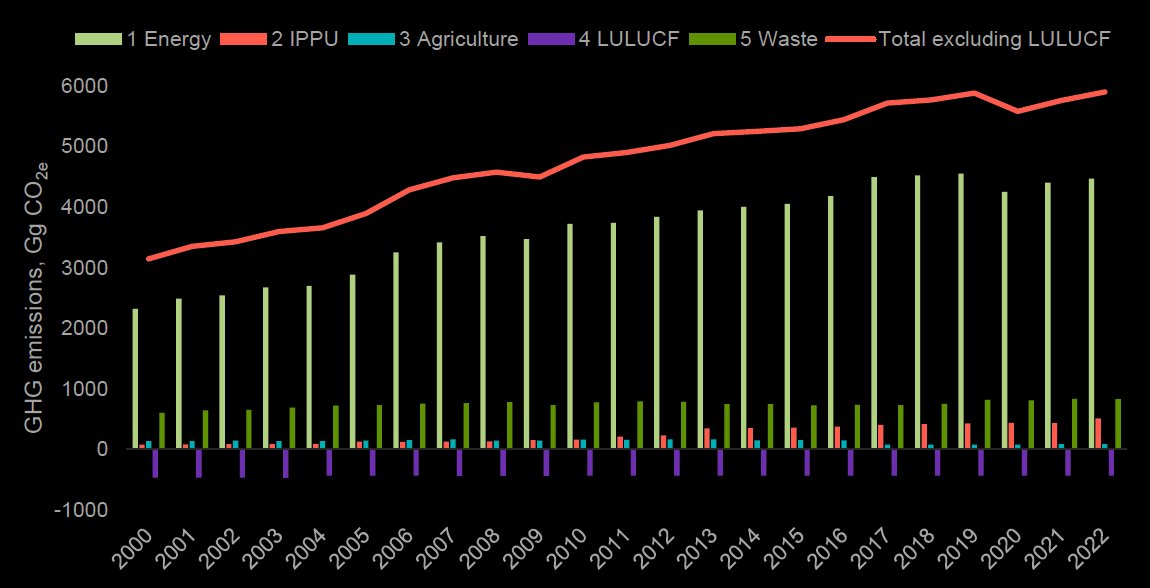
Overall Trend of Emissions for Mauritius (from 2000 to 2022) | ||
Since achieving independence in 1968, Mauritius has undergone significant economic development and now boasts one of the highest per capita incomes in Africa. In the 1980s, the country diversified its economy, advancing notably in the textile, tourism, fisheries, and manufacturing sectors. Entering the 21st century, Mauritius expanded further into financial services and information and communication technology. From 2000 to 2022, the Republic of Mauritius saw a 174% increase in its real Gross Domestic Product (GDP), accompanied by a 104% rise in net GHG emissions during the same timeframe. The overall trend suggests a fairly stable total emission level over the years, with slight fluctuations. | 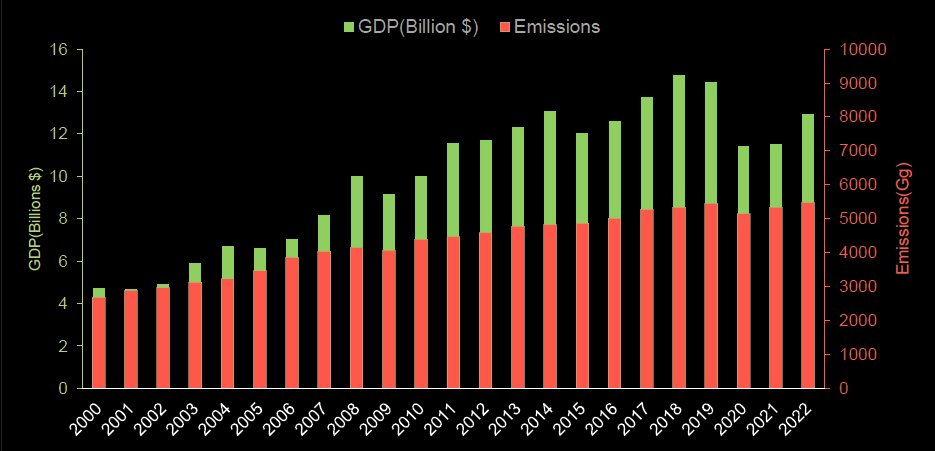 Evolution of GDP and Net GHG Emissions | |
From 2000 to 2022 (Biennial Transparency Report (BTR), 2024):
The dominant role of the energy sector highlights its significant impact on the country's GHG emissions profile. | 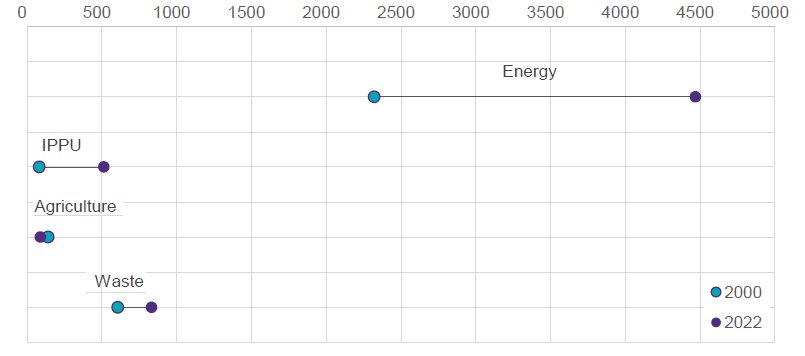 2000 emissions vs 2022 emissions (Gg CO2e) | |
| This interactive chart, from the Gapminder Tool, shows the historical trends of GHG emissions per capita against the GDP per capita for Mauritius. | ||
GHG Emission Trends by Sector | ||
The GHG national inventory is divided into four main sectors i.e. Energy, IPPU, AFOLU and Waste.
Trends of total GHG emissions and removals in Mauritius from 2000 to 2022. Further each sector is subdivided into sub-categories. Click on the titles below for more info on sectoral emissions: | ||
General Observations | ||
Major GHG Emitters Undergoing TransformationBoth the electricity sector and the transport sector, the largest greenhouse gas emitters, are undergoing rapid, transformational, and inter-related changes that will significantly alter their emissions profiles. Solid Waste accounts for almost one-fifth of national emissions. Improved estimation of the GHG characteristics of these sectors/sub-sectors would have a tangible impact on the national inventory. Marginal Benefits from Inventory Improvements in Other SectorsMost of the other sectors and sub-sectors would also benefit from improvements to the national greenhouse gas inventory. However, many such improvements would improve the accuracy of the inventory only marginally. Iron and Steel Production, for example, forms a prominent component of the Industrial Processes and Product Use (IPPU) sector and is currently analyzed using a Tier 1 approach. But Iron and Steel Production accounts for less than 1% of national GHG emissions. Forestry Sector and Carbon SequestrationCarbon sequestration is currently equivalent to a substantial 8% of national GHG emissions. The Forestry sector is subject to considerable uncertainty due to gaps in activity data and the methodology used for calculating GHG removal. Agricultural Sector's Contribution to GHG EmissionsAgriculture accounts for nearly 3% of national GHG emissions, one-quarter of which are attributable to livestock (enteric fermentation and manure). Data paucity is specifically identified by the 2021 National Greenhouse Gas Inventory Report (p. 94) as a key barrier to estimating Livestock GHG emissions: “Some activity data and EFs had to be estimated by using expert knowledge. It is anticipated to empower Food and Agricultural Research and Extension Institute (FAREI) to improve collection of livestock population data and develop local emission factors to reduce the uncertainty level.” Mauritius' Enhanced GHG Emission Reduction TargetsMauritius aims to reduce overall GHG emissions by 40% in 2030 compared to the Business as Usual (BAU) scenario of around 6,900 ktCO2eq (including LULUCF) in 2030. Compared to the 2015 INDC target of 30% GHG emissions reduction by 2030, the mitigation ambition of Mauritius in the updated NDC is significantly enhanced. | ||
Mitigation Measures | ||
As per the updated NDC (2021), the total financial needs to implement the NDC targets are estimated at USD 6.5 billion. The total needs for implementing the mitigation and adaptation actions identified in this NDC are estimated respectively at USD 2 billion and USD 4.5 billion. Planned mitigation options for ROM include an increase in the use of renewable energy, marine resources and cleaner energy technologies, modernisation of the electricity grid and energy efficiency measures, sustainable transportation including efficient mass transportation, sustainable and integrated waste management programme, climate smart agriculture and sustained tree planting programme. More.. | ||