
Historical accounts paint a picture of Rodrigues as a lush island with dense forests dominated by endemic ebony trees. Sadly, these forests have been largely cleared for agriculture and firewood.
Biodiversity-Related ODE Sites:
- Rodrigues Biodiversity: Terrestrial (Flora; Fauna); Coastal & Marine; Wetlands;
- Mauritius Biodiversity: Terrestrial (Flora; Fauna); Coastal & Marine; Wetlands;
- National Parks and Conservation Service: Flora; Fauna; Islet Biodiversity; Ramsar Sites - Wetlands; Protected Endemic Sanctuaries;
Flora of Rodrigues |
Rodrigues once boasted lush forests dominated by unique and endemic plant species, including hardwoods like the endemic ebony trees. These forests were largely cleared over time for agriculture, grazing, and firewood, resulting in significant habitat loss and species decline.
Despite this, the island still supports a rich and distinct flora, with around 150 native plant species, of which 47 are endemic—found nowhere else in the world.
Tragically, over 21% of these endemic plants are now extinct, primarily due to deforestation, invasive species, and environmental degradation.
Nine of the endemic species in Rodrigues are represented by fewer than 10 mature individuals in the wild, including three species (Ramosmania rodriguesii, Dombeya rodriguesiana and Gouania leguatii (MWF 2012) which are known from just a single individual. Other species groups show similar levels of endemism.
Conservation efforts are underway to restore native vegetation and safeguard the remaining flora, including through forest restoration projects, seed banking, and propagation of rare species in nurseries.
Rodrigues continues to be a critical island ecosystem in the Mascarene region for plant conservation and ecological restoration.
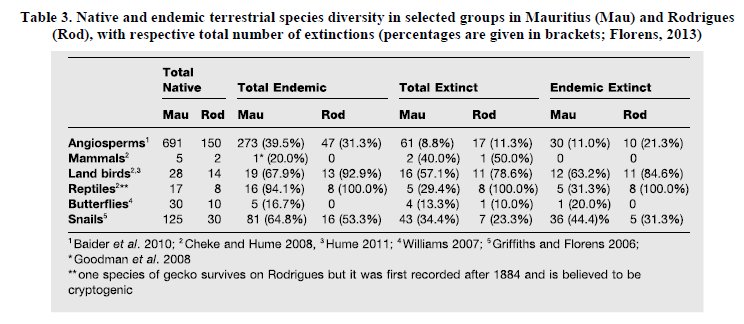
Rodrigues hosts a total of 150 native flowering plant species (angiosperms), of which 47 species (31.3%) are endemic to the island. 72 are Mascarene endemics (Baider et al., 2010). This reflects a high level of endemism relative to the island’s size, highlighting its unique botanical heritage.
However, 17 native species (11.3%) have gone extinct, including 10 endemic species, representing an endemic extinction rate of 21.3%. This significant biodiversity loss is largely due to deforestation, land conversion for agriculture, overgrazing, and the spread of invasive species.
Despite these losses, Rodrigues still retains important pockets of native flora and remains a conservation priority within the Mascarene region for the restoration and protection of its remaining endemic plant species.
Despite the deforestation, Rodrigues still harbours a significant number of endemic plants. These resilient species include the Mandrinette de Rodrigues (Hibiscus liliiflorus), the ‘Bois gandine’ (Mathurina penduliflora), the ‘Bois fer’ (Eugenia rodriguesensis), the ‘Bois puant’ (Foetidia rodriguesiana), Bois Capot, also known as Bois de Remède, is famous for its medicinal properties and is used in traditional medicine, Bois de Pirogue, has cultural and historical significance, as it was traditionally used for making canoes, Filewood is known for its dense foliage and attractive flowers and Palms such as the Rodrigues fan palm and the Latanier palm. The national flower of Mauritius, Trochetia Boutoniana, is also found on Rodrigues. It has bright red tubular flowers that bloom in abundance. Reforestation initiatives using native species are underway to restore lost habitat and provide vital resources for endemic fauna. 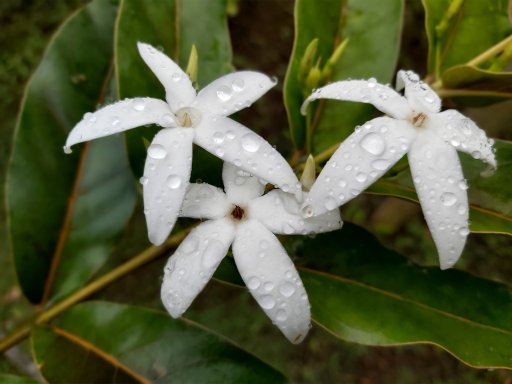 cafe marron flowering (courtesy: MWF) 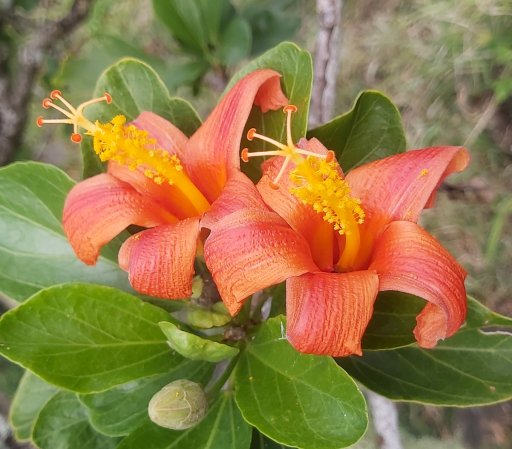 Mandrinette de Rodrigues (Hibiscus liliiflorus) (courtesy: MWF) | 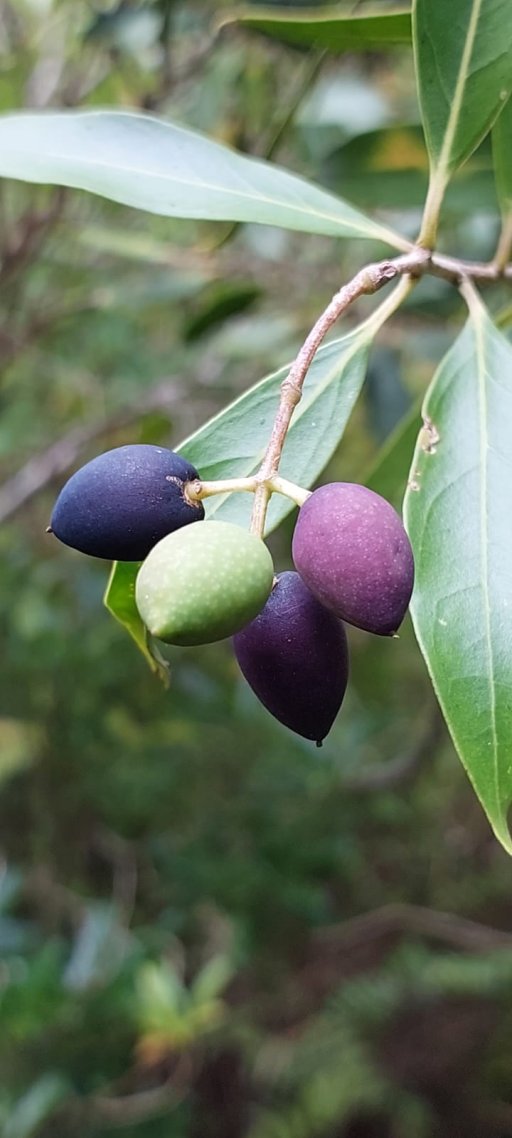 olea lancea (courtesy: MWF) |
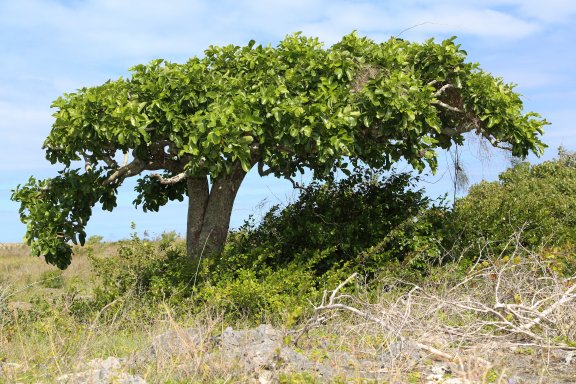 Polyscias rodriguesiana (courtesy: MWF) | 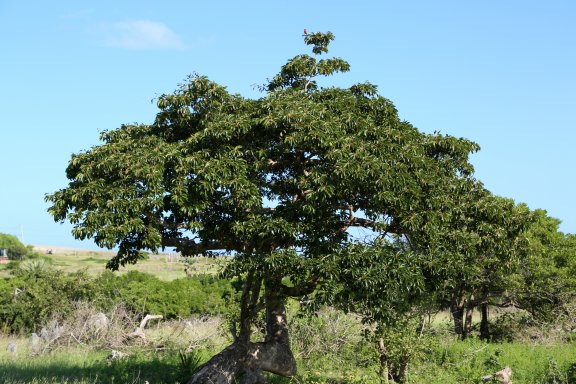 Terminalia bentzoe subsp rodriguesensis (courtesy: MWF) |