
Air Quality

Air quality is a measure of the condition of the air in our environment, focusing on the presence of pollutants. Air pollution results from the introduction of harmful substances, including pollutants, particulate matter, and gases into the Earth's atmosphere, primarily caused by human activities such as industrial processes, transportation, and the combustion of fossil fuels.


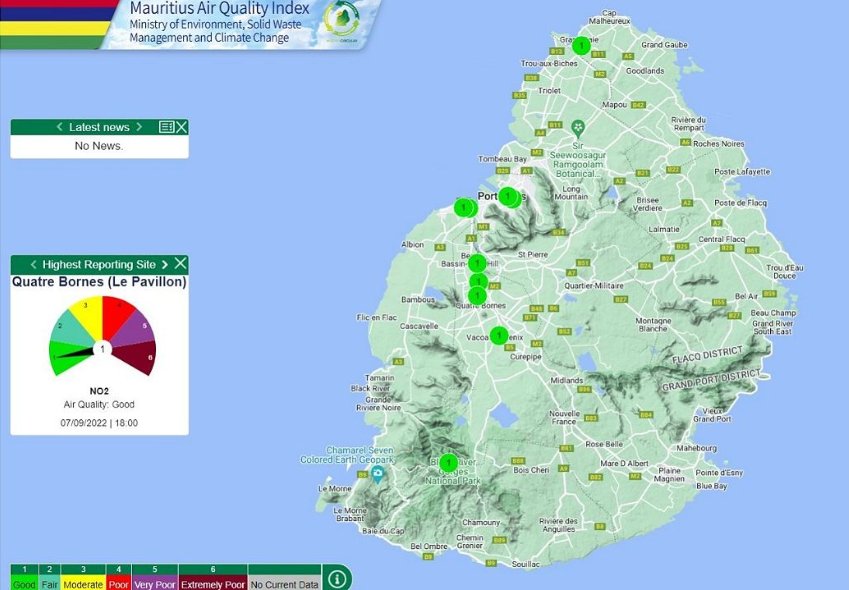
Real-Time Air Quality Dashboard 

Explore our interactive dashboard featuring up-to-date air quality indexes (AQI) from monitoring stations across Mauritius.  

Click on the map to view detailed air quality statistics, 

including concentrations of specific pollutants and historical data trends.


THE ENVIRONMENT ACT (EA) 2024 establishes that “"air” includes ambient or localised air within a building, a vehicle, an enclosure or a structure". 
National standards apply "to protect the quality of air resources so as to promote the public health and welfare, and the development and the productive capacity of human, animal or plant life"."These include four segments, namely:
(a) minimum essential air quality; 
(b) the control of concentration of substances in the air which, separately or in combination, are likely to result in damage or deterioration of property, and of human, animal and plant health; 
(c) controls for atmospheric pollution originating from energy and industrial sources, including pollution produced by craft and other self-propelled vehicles, and by factories and power generating stations; and 
(d) standards applicable to emission from mobile sources, causing or contributing to air pollution"

see also Environmental Protection (Standards for Air) Regulations 1998