
Disasters can be classified in several ways. The Republic of Mauritius experiences a range of hazards, as indicated below, grouped based on the guidance provided by the Hazard Definition & Classification Review Technical Report.
Disasters (By Event)
Hazards & Descriptions | Disaster Events* | ||
Meteorological and Hydrological Hazards These hazards stem from atmospheric and hydrological conditions, including extreme weather events and water-related phenomena. They encompass cyclones, floods, droughts, and other weather-driven incidents that can lead to widespread environmental and infrastructural damage. 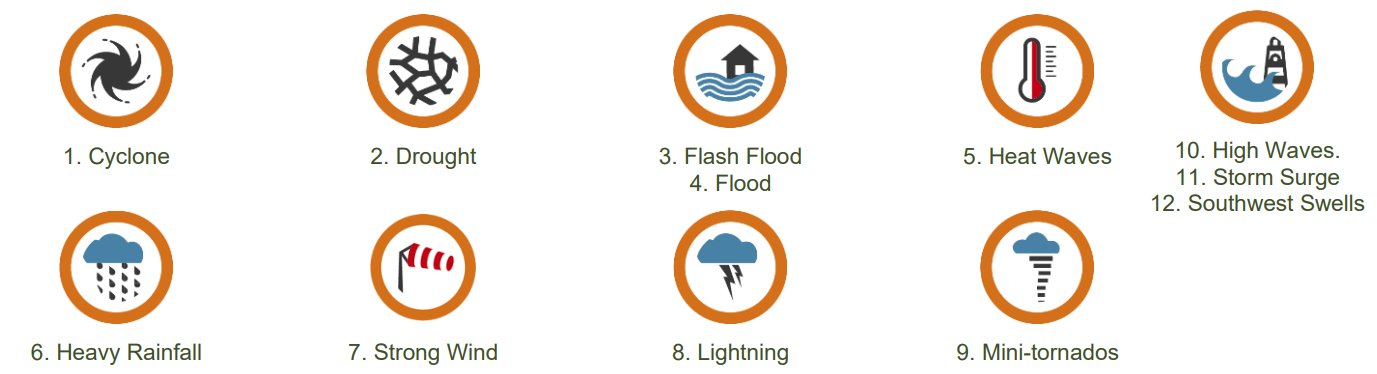 | Main disaster events affecting Republic of Mauritius for period 2024-2025
| ||
Environmental Hazards Environmental hazards involve events that adversely affect the natural environment, which can include wildfires and vegetation fires. These hazards pose significant risks to ecosystems, human health, and property.  | |||
Biological HazardsBiological hazards are associated with threats posed by organisms, such as viruses, bacteria, insects, and other pathogens, leading to diseases in humans, animals, and plants. This category also includes concerns related to invasive species.
|
| ||
Chemical Hazards Chemical hazards refer to dangers arising from chemical substances that can cause harm to humans, animals, and the environment. Negligent maintenance and operational practices in various industries can lead to disastrous outcomes. This includes industrial chemical spills, pollution, and toxic waste incidents.
|
| ||
Geo Hazards Geo hazards are related to geological processes and movements, including earthquakes, tsunamis, volcanic eruptions, and land movements such as landslides and rockfalls. These hazards can result in significant physical changes to the earth’s surface and pose threats to life and property. 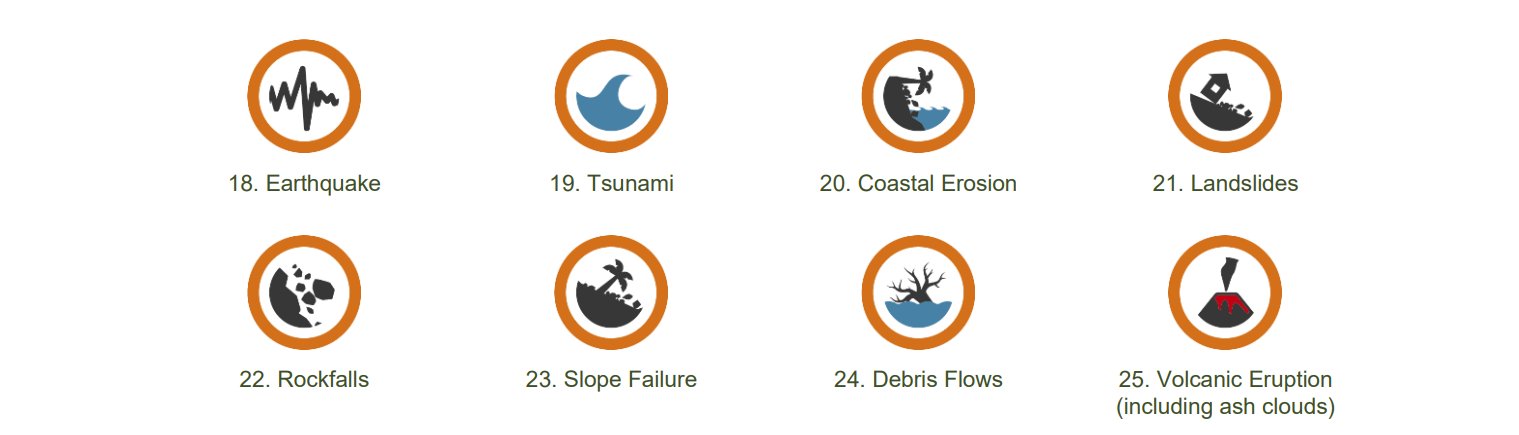 |
| ||
Technological Hazards Technological hazards arise from technological or industrial conditions, including accidents or the failures of systems and structures such as aircraft accidents, building collapses, and infrastructure failures. They also cover incidents involving hazardous materials and pollution that adversely affect health and safety. Disasters related to food safety typically stem from poor hygiene practices by those handling food, incorrect use of materials in food preparation, or insufficient quarantine measures at international borders. 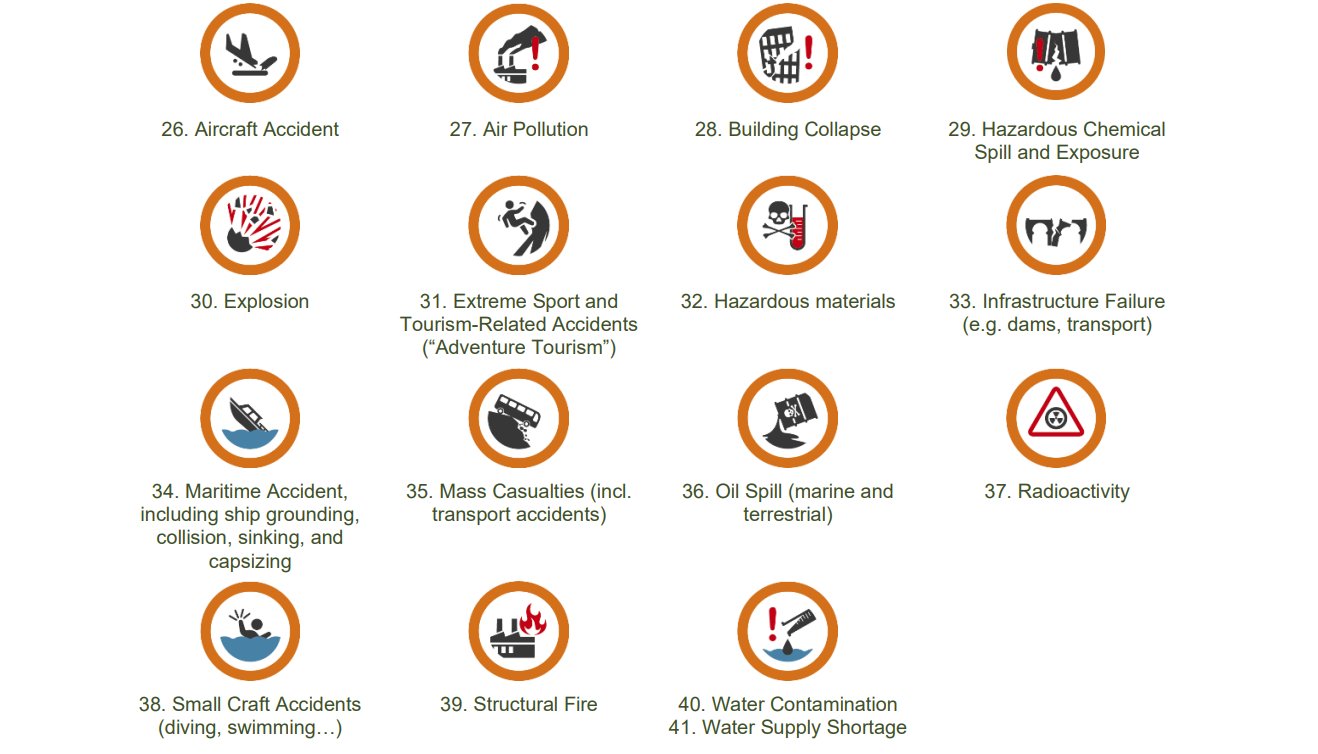 |
| ||
| * | This categorization includes important subtleties. For example, while cyclones are a major hazard for the Republic of Mauritius, their impact varies. Typically, cyclones cause damage through high winds and heavy rainfall, which can lead to flash floods and landslides. However, certain cyclones may bring minimal rainfall and primarily cause damage through high winds alone, without leading to flooding or landslides. | ||


History of Major Disasters
Period | Type | Name | Remarks | |
| 2015 | 16 January 2015 | Tropical Cyclone | Bansi | Tropical Cyclone Bansi passed northeast of Rodrigues, bringing heavy winds and rainfall to the entire island. 1,400 individuals sought shelter in 14 national evacuation centers. Notably, a bridge collapsed at Notre Dame in central Mauritius, and landslides affected Kewal Nagar on the island's western side. |
| 2018 | 13-17 January 2018 | Tropical Cyclone | Berguitta | Rodrigues- 230 km northeast of the island, moving west-southwest. Mauritius Island - 70 km south of Mauritius. Tropical Cyclone Berguitta delivered over 500 mm of rain in a single day, impacting 10,000 families. A total of 3,600 individuals evacuated, finding shelter in 57 of the 171 government-operated evacuation centers prepared in anticipation of the storm. Significant damage occurred to numerous roofs, and some homes experienced flooding that ruined household items. |
| 2019 | February 2019 | Tropical Cyclone | Gelena | The storm's progression south and east of Rodrigues led to the evacuation of 142 people to island refuge centers, and 90% of the island's population experienced power outages, accompanied by significant transport disruptions. Additionally, flash floods from the cyclone displaced another 259 people and caused extensive damage to infrastructure, private homes, and farms. |
| 2019 | February-July 2019 | Dengue Outbreak | This dengue outbreak resulted in 141 confirmed cases, including 11 imported ones. The cases were predominantly in Roche Bois, Vallée des Prêtres, and Cité la Cure, across five districts, with an incidence rate of 10.6 per 100,000 inhabitants and no fatalities. | |
| 2019 | 28 Mar | Tropical Cyclone | Joaninha | The cyclone injured four people and displaced 83 others on the island of Rodrigues. Over 100 houses suffered damage from the strong winds, and the electrical grid was severely impacted. |
| 2018-2019 | April 2018 – June 2019 | Measles Outbreak | Mauritius experienced a measles outbreak alongside Madagascar, Réunion, and Comoros, reporting 1,482 cases and four deaths. Despite its nearly 100% measles vaccination coverage, the outbreak resulted in an incidence rate of 116 cases per 100,000 inhabitants and a case fatality rate of 0.27%. The two hardest-hit districts saw incidence rates ranging from 150 to 225 per 100,000 inhabitants. The outbreak may have been spurred by a decrease in vaccination rates in these districts during 2015, 2016, and 2017. | |
| 2020-2023 | as from mid-March 2020 | COVID-19 Pandemic | - | The first three COVID-19 cases in Mauritius were detected on March 18, 2020, leading to a stringent lockdown lasting over a month. By late April 2020, cases were sporadic and mostly imported until a significant outbreak in March 2021 coincided with the vaccine rollout, prompting an increase in vaccination efforts. By late 2021, Mauritius had logged over 68,000 cases and 786 deaths, with over 72% of its population fully vaccinated, although Rodrigues had a lower rate of about 64%. By early 2022, vaccination coverage exceeded 76%, with 928,000 individuals fully vaccinated, and substantial vaccination uptake among teenagers and younger children. Despite subsequent spikes in infections in May and November 2023, the high vaccination rates prevented overwhelming the healthcare system. As of December 2023, Mauritius had reported a total of 315,100 COVID-19 cases and 1,056 deaths. |
| 2020 | 25 July | Grounding and Oil Spill | MV Wakashio | Japanese-owned MV Wakashio oil carrier ran aground on coral reefs about 1.8 km off Pointe d’Esny. By August 6, the vessel began leaking oil, prompting the government to declare a state of emergency. The resulting spill affected a 27 km^2 area from Blue Bay Marine Park to Ile aux Cerfs, mobilizing a response from national authorities, local communities, the UN, international groups, CSOs, and volunteers. Approximately 1,000 tons of oil were spilled, although another 3,800 tons were successfully extracted from the vessel. On August 15, the vessel split into two, leading to a plan to tow the bow section 8 nautical miles from the reef. |
| 2021 | 15-20 April | Flooding and Landslides | Intense rainfall in southern Mauritius resulted in flash floods and landslides, prompting evacuations and damaging homes and roads. In the Grand Port District, particularly in Bambous Virieux and Petit-Bel-Air, nine individuals were evacuated. Multiple rescue operations were carried out as infrastructure sustained significant damage. | |
| 2022 | 2 February | Tropical Cyclone | Batsirai | Public transport was suspended, and shops, banks, and air and sea services closed until the storm subsided. The National Crisis Committee reported significant loss of tree branches and damaged electrical lines, and 138 people sought refuge in emergency shelters. Approximately 7,500 people were initially without power, though power was quickly restored to 5,000. One fatality was reported related to the storm. |
| 2022 | 13 March | Flooding | – | Days of intense rainfall led to severe floods across multiple regions of the country, causing extensive damage to homes, roads, and bridges. On March 13, flash floods struck Port Louis and surrounding areas. One individual lost their life while hiking in the Rivière Noire district. The deluge swept away vehicles, and four individuals were rescued from their homes in Vallée-des-Prêtres,. Additionally, floodwaters obstructed various roads, including segments of the M2 motorway in the capital. |
| 2023 | February | Tropical Cyclone | TC Freddy – | Media reported one fatality, and at least 500 families were displaced to shelters across the main island. Mauritius response agencies were mobilized following reports that a Taiwan-flagged fishing vessel had capsized in the storm, located just outside Mauritius’ territorial waters; unfortunately, a rescue operation could not be conducted. |
| 2023-2024 | December -March | Dengue Outbreak | - | During Mauritius's largest-ever dengue outbreak, over 4,600 cases were reported across Mauritius Island and Rodrigues over four months, resulting in four deaths by late March 2024. |
| 2024 | 14-15 January | Tropical Cyclone | Belal | On 16 January, the MRCS reported that two people had been killed, 100,000 people were affected, infrastructure had been damaged, and cars had been washed away or submerged amid the rains and subsequent flooding. |